Stop trying to eliminate resistance.
Start designing for it.
Most leaders misunderstand resistance.
They treat it like friction to remove.
Something to push through.
A sign people “don’t get it.”
But here’s the reality:
Resistance is not opposition.
It’s unprocessed understanding.
It’s the visible gap between when you see the future…
and when others believe in it.
I’ve been working on this idea across systems strategy, architecture, and change:
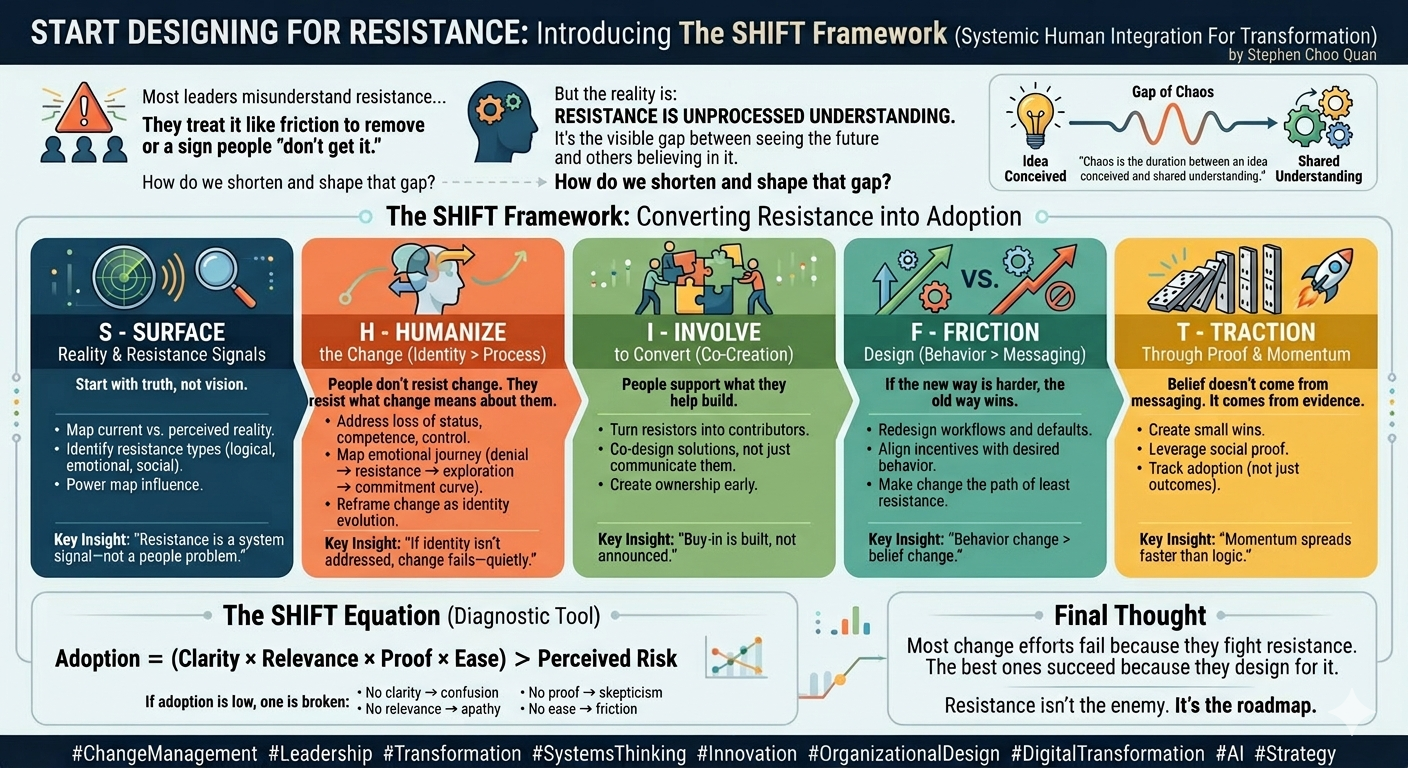
“Chaos is the duration between an idea conceived and shared understanding.”
So the question isn’t:
“How do we eliminate resistance?”
It’s:
How do we shorten and shape that gap?
Introducing: The SHIFT Framework
(Systemic Human Integration For Transformation)
A system to convert resistance into adoption.
S — Surface Reality & Resistance Signals
Start with truth, not vision.
- Map current vs perceived reality
- Identify resistance types (logical, emotional, social)
- Power map influence (who actually drives adoption)
👉 Resistance is a system signal—not a people problem.
H — Humanize the Change (Identity > Process)
People don’t resist change.
They resist what change means about them.
- Address loss of status, competence, control
- Map emotional journey (denial → resistance → exploration → commitment)
- Reframe change as identity evolution
👉 If identity isn’t addressed, change fails—quietly.
I — Involve to Convert (Co-Creation)
People support what they help build.
- Turn resistors into contributors
- Co-design solutions, not just communicate them
- Create ownership early
👉 Buy-in is built, not announced.
F — Friction Design (Behavior > Messaging)
If the new way is harder, the old way wins.
- Redesign workflows and defaults
- Align incentives with desired behavior
- Make change the path of least resistance
👉 Behavior change > belief change.
T — Traction Through Proof & Momentum
Belief doesn’t come from messaging.
It comes from evidence.
- Create small wins
- Leverage social proof
- Track adoption (not just outcomes)
👉 Momentum spreads faster than logic.
The SHIFT Equation (Diagnostic Tool)
Adoption = (Clarity × Relevance × Proof × Ease) > Perceived Risk
If adoption is low, one of these is broken:
- No clarity → confusion
- No relevance → apathy
- No proof → skepticism
- No ease → friction
Final Thought
Most change efforts fail because they fight resistance.
The best ones succeed because they design for it.
Resistance isn’t the enemy.
It’s the roadmap.
#ChangeManagement #Leadership #Transformation #SystemsThinking #Innovation #OrganizationalDesign #DigitalTransformation #AI #Strategy