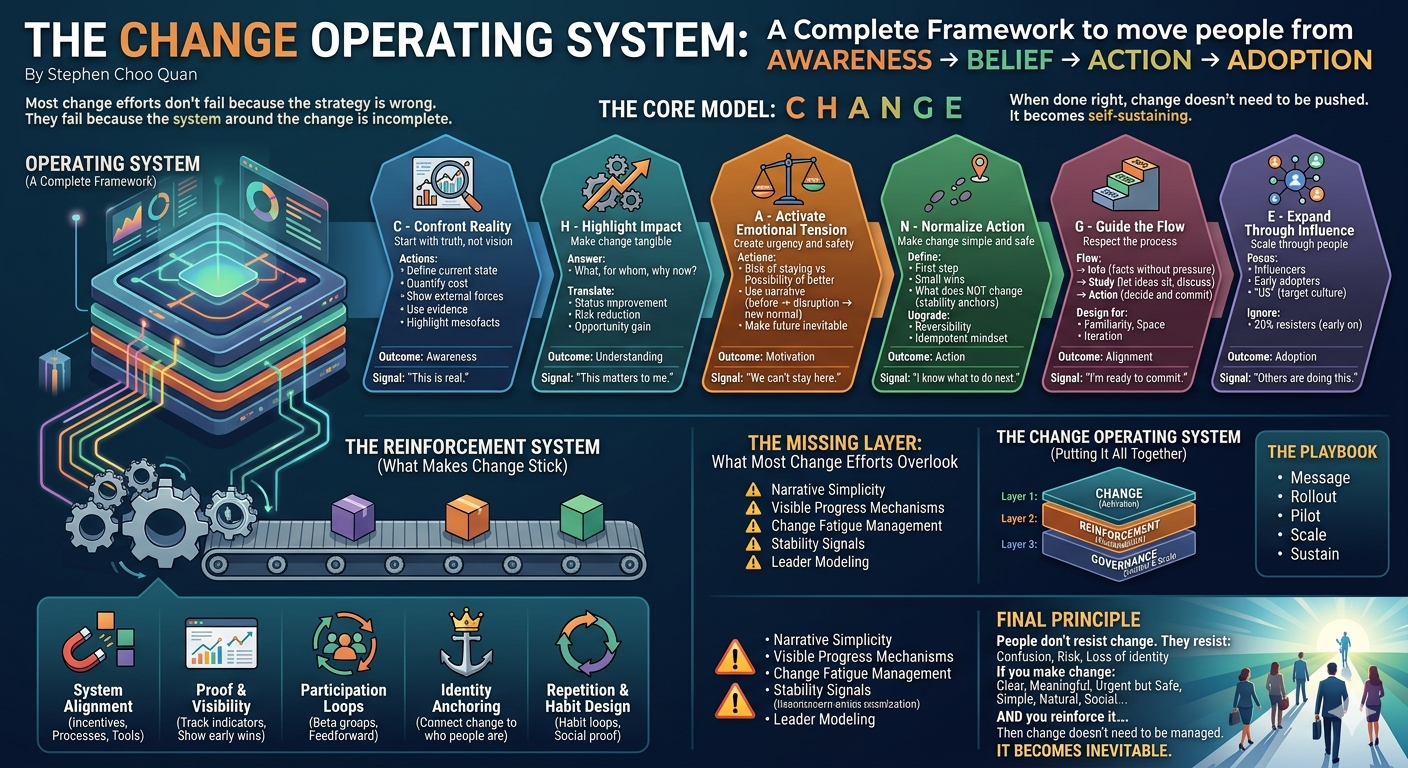
A system to move people from awareness → belief → action → adoption
Most change efforts don’t fail because the strategy is wrong. They fail because the system around the change is incomplete.
Change isn’t a message.
It’s an operating system.
When done right, change doesn’t need to be pushed.
It becomes self-sustaining.
The Core Model: CHANGE
A simple, repeatable structure for communicating and activating change.
C — Confront Reality
Start with truth, not vision.
Before people move forward, they need to clearly see where they are.
Do this:
- Define the current state in concrete terms
- Quantify the cost of not changing
- Show external forces (market, technology, behavior shifts)
- Use evidence and patterns—not opinions
- Highlight mesofacts (slow, inevitable shifts)
Outcome: Awareness
Signal of success: “This is real.”
H — Highlight Impact
Make change tangible and relevant.
People don’t act on ideas—they act on perceived impact.
Answer clearly:
- What will change?
- For whom?
- Why now?
Translate into:
- Status improvement
- Risk reduction
- Opportunity gain
Outcome: Understanding
Signal of success: “This matters to me.”
A — Activate Emotional Tension
Create the right balance of urgency and safety.
Change requires tension:
- Enough discomfort to move
- Enough safety to act
Do this:
- Show the risk of staying the same
- Show the possibility of something better
- Use narrative: before → disruption → new normal
- Make the future feel inevitable
Outcome: Motivation
Signal of success: “We can’t stay here.”
N — Normalize Action
Make change simple, safe, and doable.
Big change fails. Small movement succeeds.
Define:
- The first step
- Small wins
- What does NOT change (stability anchors)
Upgrade:
- Emphasize reversibility (low risk)
- Promote an idempotent mindset (safe to try again)
Outcome: Action
Signal of success: “I know what to do next.”
G — Guide the Flow (ISA: Info → Study → Action)
Respect how people process change.
Change adoption is a sequence, not an event.
- Info: Share facts without pressure
- Study: Let ideas sit, discuss, iterate
- Action: Decide and commit
Design for:
- Familiarity over time
- Space for discussion
- Iteration before commitment
Outcome: Alignment
Signal of success: “I’m ready to commit.”
E — Expand Through Influence
Scale through people, not announcements.
Change spreads through networks, not org charts.
Focus on:
- Influencers and early adopters
- Those already open to change
- Your “US” (target culture)
Ignore:
- The 20% who will never support it (early on)
Outcome: Adoption
Signal of success: “Others are doing this.”
The Reinforcement System (What Makes Change Stick)
The CHANGE model creates movement.
This layer turns movement into momentum.
1. System Alignment
Behavior follows structure.
- Align incentives with desired behavior
- Update processes to reflect the change
- Ensure tools enable—not block—the change
Audit:
- What behaviors are rewarded today?
- What behaviors are penalized?
2. Proof & Visibility
People believe what they can see.
- Create visible dashboards
- Track leading indicators (not just outcomes)
- Show early wins and progress signals
Measure:
- Behavior change
- Engagement levels
- Decision speed
3. Participation Loops
Ownership drives adoption.
- Use beta groups
- Build feedback loops
- Ask: “What are we missing?”
Upgrade:
- Use feedforward (future-focused input)
- Replace “why” with “what”
4. Identity Anchoring
Sustainable change is identity-based.
- Connect change to who people are
- Reinforce who they are becoming
Repeat:
- “This is what we do here.”
- “This is who we are now.”
5. Repetition & Habit Design
Consistency rewires belief.
- Make actions obvious
- Make them easy
- Make them rewarding
Use:
- Habit loops
- Social proof
- Repetition in messaging
The Missing Layer: What Most Change Efforts Overlook
1. Narrative Simplicity
If people can’t repeat it, they won’t adopt it.
Rule:
- One message
- One story
- One model
2. Visible Progress Mechanisms
Momentum requires proof.
Build:
- Dashboards
- KPIs tied to behavior
- Real-time progress indicators
3. Change Fatigue Management
Too much change = no change.
Manage by:
- Sequencing initiatives
- Prioritizing ruthlessly
- Creating recovery space
4. Stability Signals
Change works when people feel grounded.
Always define:
- What is NOT changing
- What remains stable
5. Leader Modeling
People follow behavior, not communication.
If leaders don’t change:
- Nothing changes
The Change Operating System (Putting It All Together)
Think of this as a stack:
Layer 1: CHANGE (Activation)
- Awareness → Understanding → Motivation → Action → Adoption
Layer 2: Reinforcement (Sustainability)
- Systems → Proof → Participation → Identity → Habits
Layer 3: Governance (Control & Scale)
- Narrative simplicity
- Measurement systems
- Fatigue management
- Stability signals
- Leadership modeling
The Playbook (How to Use This)
1. Message
- Define reality
- Articulate impact
- Tell a simple story
2. Rollout (ISA)
- Info sessions
- Study groups
- Action commitments
3. Pilot
- Start with early adopters
- Capture wins
- Refine approach
4. Scale
- Expand through influence networks
- Reinforce with proof
5. Sustain
- Align systems
- Track adoption
- Reinforce identity
Final Principle
People don’t resist change.
They resist:
- Confusion
- Risk
- Loss of identity
If you make change:
- Clear (Confront Reality)
- Meaningful (Highlight Impact)
- Urgent but Safe (Activate Tension)
- Simple (Normalize Action)
- Natural (Guide the Flow)
- Social (Expand Through Influence)
And you reinforce it with:
- Systems
- Proof
- Participation
- Identity
Then change doesn’t need to be managed.
It becomes inevitable.
1. Start With Reality (Not Vision)
“See things as they are, not as you want them to be.”
Best Practice:
- Clearly define the current state
- Quantify the cost of not changing
- Show external forces (market, tech, behavior shifts)
- Use evidence + patterns, not opinions
- Highlight mesofacts (slow but inevitable shifts)
Why it works:
People don’t resist change—they resist unclear or unnecessary change.
2. Define the Change in Terms of Impact
“Marketing is the promise of change. Impact is the delivery of it.”
Best Practice:
- Answer:
- What will change?
- For whom?
- Why does it matter now?
- Focus on outcomes, not activities
- Translate change into:
- Status improvement
- Risk reduction
- Opportunity gain
Why it works:
People adopt change when they feel the difference, not just understand it.
3. Create Emotional Tension (Safety + Risk)
Change requires both comfort and discomfort.
Best Practice:
- Show:
- The risk of staying the same
- The possibility of something better
- Balance:
- “You’re safe” + “This won’t work anymore”
Why it works:
Too much fear → paralysis
Too much comfort → complacency
Upgrade:
- Use storytelling (before → disruption → new normal)
- Make the future feel inevitable
4. Make Change Concrete and Achievable
“Break it into small, reversible steps.”
Best Practice:
- Define:
- First step
- Small wins
- What does NOT change (stability anchors)
Why it works:
Ambiguity kills momentum.
Upgrade:
- Emphasize:
- Idempotency mindset (safe to try)
- Reversibility (low risk)
5. Use the ISA Flow (Info → Study → Action)
Best Practice:
- Info: Share facts (no pressure)
- Study: Let ideas sit, discuss, iterate
- Action: Decide and commit
Why it works:
People need time to internalize change before committing
Upgrade:
- Keep ideas in “Study” long enough to:
- Build familiarity
- Reduce resistance
6. Target the Right People First (Not Everyone)
“Change spreads horizontally.”
Best Practice:
- Focus on:
- Influencers
- Early adopters
- People already open to change
Why it works:
You don’t need everyone—just the people others listen to.
Upgrade:
- Define your “US” (target culture)
- Ignore the 20% who will never support it
7. Align Systems, Not Just Messages
“People don’t change—systems change people.”
Best Practice:
- Ensure:
- Incentives support the change
- Processes reflect the change
- Tools enable the change
Why it works:
Misaligned systems kill even the best messaging.
Upgrade:
- Audit:
- What behaviors are currently rewarded?
- What behaviors are penalized?
8. Reinforce Through Repetition and Proof
“Belief follows action and evidence.”
Best Practice:
- Show:
- Early wins
- Case studies
- Visible progress
Why it works:
Repetition rewires belief (neuroplasticity)
Upgrade:
- Use:
- Habit loops (obvious, easy, rewarding)
- Social proof (others are doing it)
9. Invite Participation (Not Compliance)
Best Practice:
- Ask:
- “What should we change?”
- “What are we missing?”
- Use:
- Beta groups
- Feedback loops
Why it works:
People support what they help create.
Upgrade:
- Use feedforward (future-focused suggestions)
- Avoid defensive “why” questions → use “what”
10. Anchor Change to Identity
“You don’t change behavior—you change identity.”
Best Practice:
- Connect change to:
- Who we are
- Who we are becoming
Why it works:
Behavior that conflicts with identity won’t stick.
Upgrade:
- Reinforce:
- “This is what we do here”
- “This is who we are now”
Key Gaps to Strengthen
1. Narrative Simplicity
You have depth—but adoption requires simplicity:
- One core message
- One clear story
- One memorable framework
2. Visible Progress Mechanisms
You mention change—but not enough on:
- Dashboards
- KPIs
- Measurable proof of change
People believe what they can see moving.
3. Change Fatigue Management
You touch resistance, but not fatigue:
- Too many changes = disengagement
- Need pacing and prioritization
4. What Stays the Same
Critical and often missing:
- Stability builds trust
“Not everything is changing—here’s what isn’t.”
5. Leader Modeling
You mention leadership—but this is key:
If leaders don’t embody the change, nothing else matters.
How to Improve It Further (Next Level)
1. Create a Signature Model
Turn this into a visual:
- “The Change Stack”
- “Change Operating System”
- “Architecture of Change”
2. Build a Repeatable Playbook
Standardize:
- Messaging templates
- Meeting structures (ISA)
- Feedback loops
3. Measure Adoption, Not Just Execution
Track:
- Behavior changes
- Engagement levels
- Decision speed
4. Normalize Change as Continuous
Shift mindset:
- Not transformation → continuous evolution
Final Principle
People don’t resist change.
They resist confusion, risk, and loss of identity.
If you:
- Make it clear
- Make it safe
- Make it meaningful
- Make it visible
Then change doesn’t need to be forced.
It becomes inevitable.