By 2012, business intelligence had already moved far beyond the old MIS model of the 1980s. Reports were web-enabled, dashboards were common, drill-down was familiar, and many organizations had already begun using self-service approaches to let users explore information more directly. The real story of the next decade was not the invention of BI, but its transformation into a faster, broader, and more intelligent decision system.
BI before 2012
The roots of modern BI trace back to management reporting, data warehousing, and efforts to make information easier to share and act on. In the 1990s, web-enabled reports improved accessibility, reduced duplication, and enabled users to navigate predefined drill paths. In the 2000s, dashboards became the dominant interface, giving managers and executives quick access to summary information and key performance indicators.
That earlier era also introduced a practical challenge that still matters today: knowledge had to move beyond documents and into decisions. Organizations began to understand that reporting alone was not enough. People needed context, collaboration, and the ability to act on what the numbers were saying.
2012 as a turning point
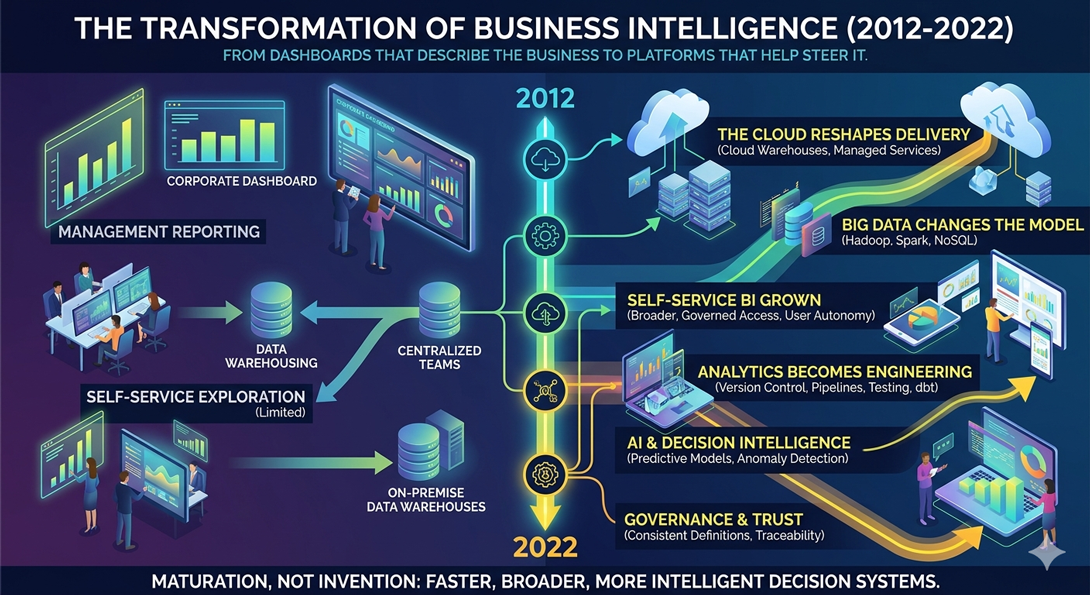
In 2012, BI was mature but still constrained. Most systems depended on centralized teams, heavy ETL processes, and on-premise data warehouses. Reporting was often slow, and users still had to wait for curated outputs before they could explore the business problem.
At the same time, expectations were rising. Users wanted faster answers, more flexible analysis, and better access to information in the flow of work. This created pressure for BI to become more interactive, more distributed, and more responsive to the business.
The self-service shift
Self-service BI did not begin in the 2010s, but it became much more important during this period. The decade expanded the idea from limited exploration into broader, easier, and more governed access to data. Business users no longer wanted only static reports; they wanted to ask follow-up questions, slice the data differently, and build their own views when needed.
This shift changed the role of BI teams. Instead of being only report producers, they increasingly became data curators, platform builders, and governance stewards. The goal was to give users autonomy without losing trust, consistency, or control.
Big data changes the model.
As data volumes grew, traditional BI systems could not handle every new use case. Big data technologies such as Hadoop, HDFS, HBase, Hive, Spark, and NoSQL platforms changed how organizations store, process, and analyze data. BI was no longer limited to structured warehouse tables; it now had to deal with logs, events, customer interactions, and other large-scale data sources.
This expansion broadened the scope of analytics. Teams could combine operational, behavioral, and external data to get a more complete picture of performance. BI became less about fixed reporting structures and more about flexible data exploration at scale.
Cloud reshapes delivery
Cloud computing was one of the biggest shifts in the decade. Instead of maintaining large on-premises BI stacks, organizations could use cloud warehouses, managed analytics services, and scalable storage and compute resources. That reduced the infrastructure burden and made it easier to scale analytics capabilities quickly.
Cloud also improved collaboration. Analysts, engineers, and business users could work from shared platforms with better availability and faster iteration. By the end of the decade, cloud was no longer just an option for BI; it had become the expected direction for modern analytics.
Analytics becomes engineering
One of the most important changes from 2012 to 2022 was the rise of analytics engineering. BI was no longer just about visualizing data. It also required more disciplined shaping, validation, testing, versioning, and maintenance of data pipelines.
This brought software practices into analytics work. Teams used testing, source control, modular transformations, and better architecture to make data workflows more reliable. The result was a BI environment that behaved less like a reporting layer and more like a product platform.
Governance and trust
As BI expanded, governance became more important, not less. More data sources, more users, and more automation increased the need for strong definitions, high-quality data, and clear ownership. Without governance, self-service could easily become confusion rather than empowerment.
This is where enterprise architecture and data management became central. Organizations needed systems that were scalable and flexible, but also trustworthy. Good BI in this period was not simply fast; it was consistent, traceable, and aligned with business meaning.
AI and decision intelligence
By 2022, BI had started to move beyond descriptive reporting into predictive and prescriptive intelligence. AI and machine learning added the ability to forecast outcomes, detect anomalies, and support more proactive decision-making. BI systems were becoming smarter about not just what happened, but what might happen next.
This is where decision intelligence enters the story. The goal was no longer just to present information. It was to combine data, models, and business context so that the right people could make better decisions at the right time.
What changed most
The biggest change over this decade was not a single tool or platform. It was the overall shape of BI itself. The field moved from centralized reporting toward a more distributed, cloud-based, and intelligent model that connected data operations, business users, and decision-making.
In simple terms, BI evolved from dashboards that described the business to platforms that helped steer it. That is the defining shift of 2012 to 2022.
My perspective
My 2012 article captured an important truth: BI has always been about helping people interpret numbers and connect the right people to the right information. The decade that followed did not replace that idea. It scaled it up, modernized it, and pushed it into cloud, big data, and AI-enabled decision support.
The state of Analytics and BI from 2012 to 2022 was therefore one of maturation rather than invention. It was the decade when reporting became more self-service, data became more distributed, and BI started shifting to data-driven decision trees that allowed predictive analysis, a true paradigm shift from queries on a database. ML Models laid the groundwork for ChatGPT, announced in 2022, and for a new era in AI, closely tied to how organizations actually interact with data.