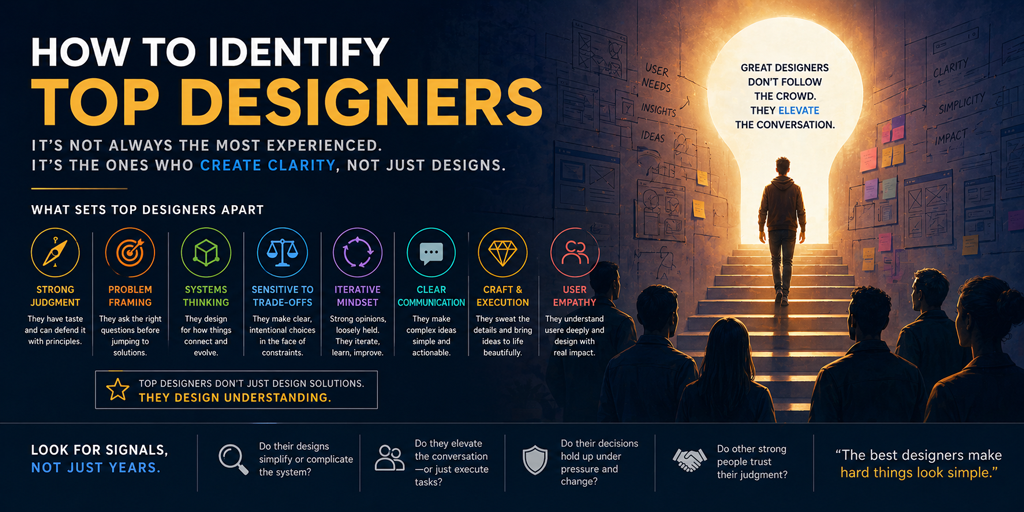
Experience helps, but it’s a weak proxy for design excellence. Some of the strongest designers aren’t the most tenured; they’re the ones who consistently produce clarity out of ambiguity and make systems feel inevitable once you see them.
Here’s how to actually identify top designers, and what sets them apart:
What Separates Top Designers
1. Taste (and the Ability to Defend It)
Top designers have strong judgment. They can tell the difference between “works” and “works well.”
More importantly, they can explain why.
Not with vague opinions, but with principles: usability, cognitive load, system constraints, trade-offs.
You’ll hear them say things like:
“This works, but it creates friction here…”
“We’re optimizing the wrong constraint…”
2. Problem Framing > Problem Solving
Average designers jump to solutions. Great designers redefine the problem.
They ask:
- What are we really trying to achieve?
- What constraints actually matter?
- Is this even the right problem?
Often, their biggest contribution isn’t the design—it’s eliminating the need for one.
3. Systems Thinking
Top designers don’t design screens or components in isolation—they design systems.
They naturally think in:
- Dependencies
- Flows
- Edge cases
- Long-term evolution
Their work scales because they anticipate how things connect and break over time.
4. Sensitivity to Trade-offs
Every design decision is a trade.
Top designers are explicit about:
- Speed vs. flexibility
- Simplicity vs. power
- Short-term delivery vs. long-term maintainability
They don’t chase “perfect”—they choose appropriate.
5. Iterative Mindset (Low Ego, High Standards)
They don’t fall in love with their first idea.
Instead:
- They prototype quickly
- Seek feedback early
- Kill their own ideas when needed
They hold two things at once:
strong opinions + willingness to change them
6. Clarity of Communication
A top designer can:
- Explain complex ideas simply
- Align stakeholders
- Make decisions legible
If people consistently “get it” after they explain, that’s a signal.
7. Craft + Execution
Ideas are cheap. Execution is rare.
Top designers:
- Sweat details
- Polish interactions
- Close the gap between concept and reality
Their work doesn’t just look good—it behaves well.
8. User Empathy (Without Blind Obedience)
They deeply understand users—but don’t blindly follow feedback.
They can distinguish between:
- What users say
- What users do
- What users need
That nuance is everything.
How to Spot Them in Practice
Instead of asking “how many years,” look for:
- Do their designs simplify or complicate the system?
- Do they elevate the conversation—or just execute tasks?
- Do their decisions hold up under pressure and change?
- Do other strong people trust their judgment?
A telltale sign:
After working with them, the problem space feels clearer—not more confusing.
The Paradox
The best designers often don’t look like “the most experienced” because:
- They question assumptions instead of reinforcing them
- They avoid unnecessary complexity (which can look “less impressive”)
- They prioritize outcomes over artifacts
In other words, they make hard things look simple—which can be mistaken for ease.
Bottom Line
Top designers aren’t defined by tenure. They’re defined by:
Clarity of thought
Strength of judgment
Ability to navigate complexity
Relentless refinement
They don’t just design solutions.
They design understanding.