From Assistance to Agency
In 2022, I first got AI assistance to write code, and for a moment, I felt invincible. I no longer had to spend as much energy wrestling with language syntax; I could cut, paste, and integrate the generated snippet directly into the codebase. Within a year, I was RAGging my own personalized data to get more specialized, context-aware answers that reflected my actual environment rather than generic examples. By 2025, the workflow had changed again: there were no more manual efforts of cut, paste, and integrate, because agent mode was making cascading changes across files and annotating the work as it went. What once took a small team years to complete was now being done in a month with just me.
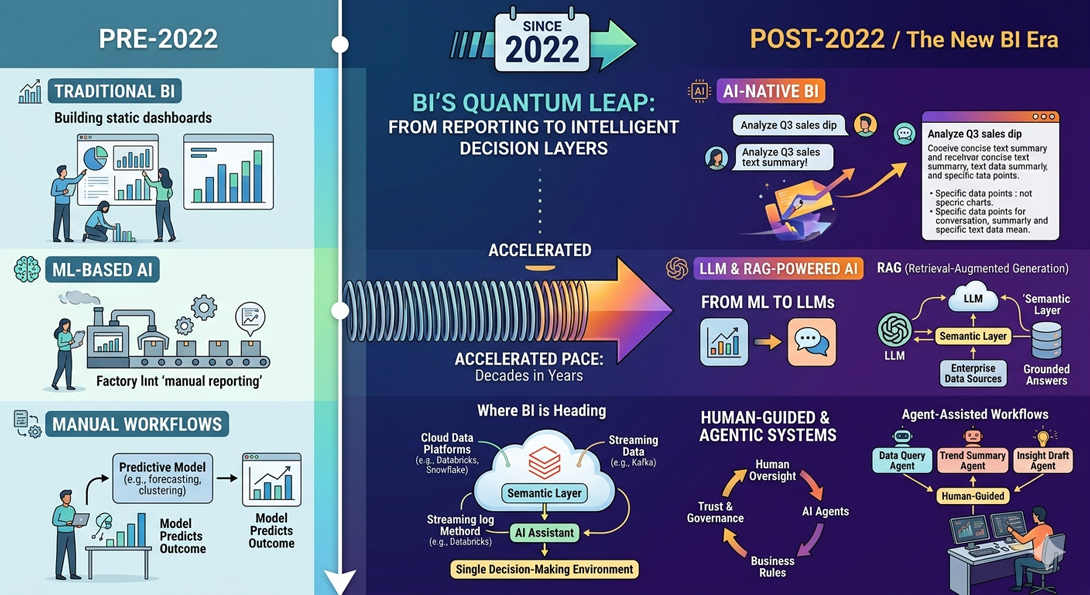
Since 2022, Analytics and BI have moved faster than any previous decade in the field. The big change is that BI is no longer just about dashboards, reporting, and cloud data platforms; it is becoming an AI-assisted decision layer built on LLMs, RAG, streaming data, governance, and human-guided agents.
The new BI era
After 2022, the center of gravity shifted from traditional analytics delivery to intelligent workflows. Data teams started combining cloud warehouses, lakehouse architectures, and governed semantic layers with tools that could explain, summarize, and recommend actions from data. This means BI is now less about manually building every answer and more about designing systems that help people ask better questions and get reliable responses faster.
From ML to LLMs
Before 2022, AI in analytics mostly meant predictive models: classification, forecasting, clustering, and optimization. Since then, the leap to large language models has completely changed the user experience, as natural language has become a practical interface for analysis, exploration, and knowledge retrieval. In BI terms, this has moved analytics from “model predicts outcome” to “AI helps users understand, explain, and act on the outcome”.
RAG and grounded AI
A major missing concept in pre-2022 analytics was retrieval-augmented generation, or RAG. RAG matters because it connects LLMs to enterprise data, making responses more grounded, up-to-date, and useful for BI and knowledge work. In practice, this means analysts and business users can ask questions in plain language while the system retrieves the right documents, metrics, and context before generating an answer.
Agent-assisted workflows
The next step after RAG is agent-assisted work. Instead of only generating text, AI systems now help with multi-step actions such as querying data, summarizing trends, drafting insights, and preparing follow-up analyses. In BI, this creates a new operating model where the human still guides the decision, but the agent handles much of the repetitive analysis and navigation.
Human-guided and agentic systems
The newest phase is the human-guided agentic build, in which AI systems operate with greater autonomy but remain under human oversight. This matters because BI is not only about producing answers; it is about trust, governance, and decision accountability. The likely future is not fully autonomous BI, but supervised agents that can retrieve, compare, explain, and act within business rules and controls.
Why does this feel so fast
Since 2022, the pace of change has felt like a decade compressed into a few years because the analytics stack changed at every layer at once. The interface changed through LLMs, the knowledge layer changed through RAG, the workflow layer changed through agents, and the operating model changed through governance and human oversight. That is why modern BI now feels less like reporting software and more like an intelligent, conversational system for decision-making.
Where BI is heading
The future of Analytics and BI is likely to integrate cloud data platforms, semantic layers, streaming data, governance, and AI assistants into a single decision-making environment. Tools like dbt, Kafka, Iceberg, Delta Lake, Databricks, and modern architecture patterns point to a world where BI is continuously updated rather than periodically reported. The best systems will not just show data; they will help organizations interpret it, trust it, and act on it faster.
My view
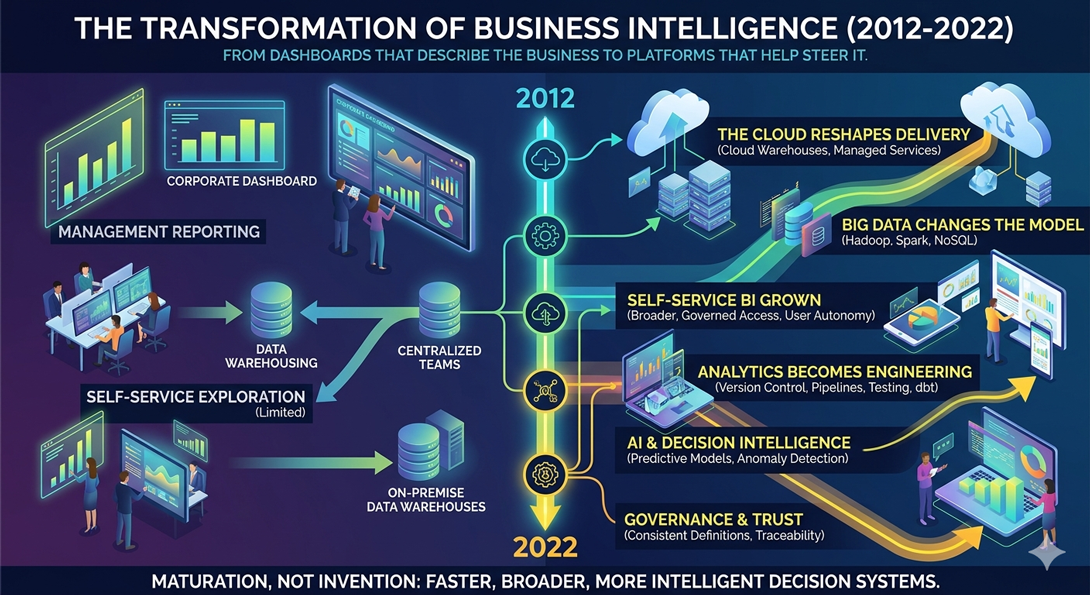
If 2012–2022 was the era of BI modernization, then 2022 onward is the era of AI-native BI. The center of value is shifting from manual reporting to augmented understanding, from dashboards to conversational analytics, and from prediction alone to grounded, agent-assisted decision intelligence. That shift is so rapid that it truly feels like several years of progress happened in only a short time.