Modern organizations have more data than ever before. They have customer records, financial transactions, operational data, analytics, streaming events, documents, images, and increasingly, data consumed by AI systems.
But having more data does not automatically create more value.
The real challenge is creating an environment where people and systems can trust the data, use it appropriately, and know that it is protected throughout its lifecycle.
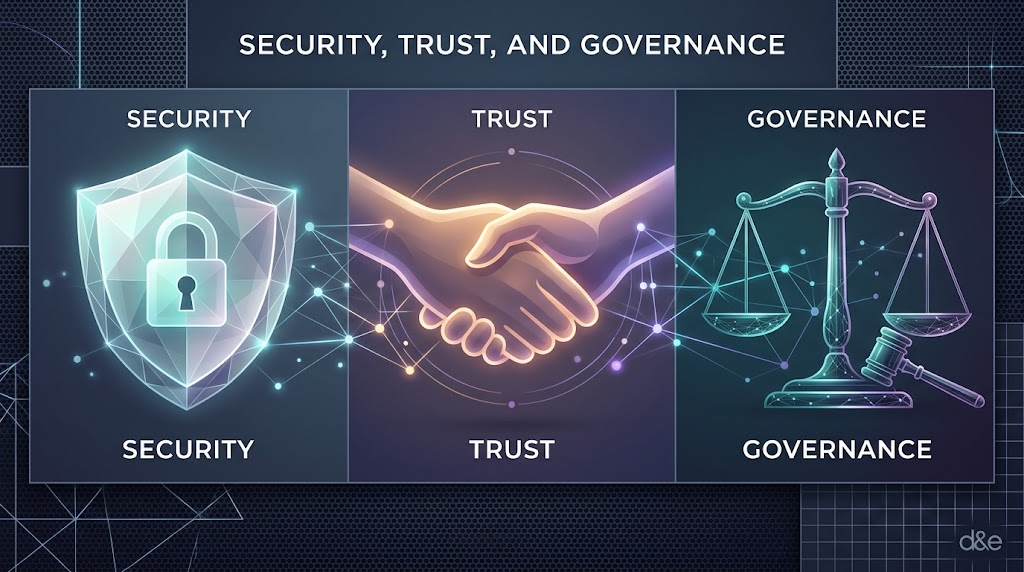
That makes security, trust, and governance more than compliance activities. They are fundamental parts of modern data architecture.
Data Exists in Three Security Zones
One of the simplest ways to think about data security is to consider the three states in which data exists:
- Data at rest: data stored in databases, files, object stores, backups, and data warehouses.
- Data in transit: data moving between applications, networks, services, databases, and users.
- Data in use: data actively being processed, queried, transformed, or analyzed.
Each state creates different risks.
Encryption at rest helps protect stored information if storage is compromised. Encryption in transit protects information as it moves across networks. Protecting data in use requires controls around identities, applications, permissions, workloads, and the environments in which processing occurs.
The important architectural principle is simple:
Security cannot be something added after the data architecture is built. Security must travel with the data.
Security Architecture Matters as Much as Data Quality
Organizations often talk about data quality:
- Is the data accurate?
- Is it complete?
- Is it timely?
- Does it conform to the expected schema?
- Can we trace where it came from (lineage)?
These are essential questions.
But there is another equally important question:
Can we trust that the right people and systems are using the data in the right way?
A perfectly accurate customer dataset can still be a serious liability if everyone can access it.
Modern data platforms therefore need to combine data quality and security.
This becomes even more important in cloud environments and multi-tenant architectures, where many applications, teams, customers, and workloads may share infrastructure.
The objective is not simply to build a wall around the data.
It is to create fine-grained control over who can access which data, under what circumstances, and for what purpose.
Protect Both the Control Plane and the Data Plane
Modern architectures can be thought of as having two important dimensions.
The data plane is where the actual business data moves and is processed.
The control plane manages how the environment operates: identities, policies, configurations, permissions, certificates, keys, and other controls.
Both require protection.
Encryption protects the confidentiality of data. Certificates help establish trusted identities and secure communications. Access controls determine who can perform particular actions. Policies govern what those identities are allowed to do.
This leads to an important principle:
A secure data platform is not simply an encrypted database. It is an ecosystem of identities, policies, networks, encryption, monitoring, and controls.
If one layer is weak, the overall system can be weak.
Classification Creates Context
Not all data deserves exactly the same level of protection.
A public marketing document is fundamentally different from a customer’s financial information. A business KPI may be widely distributed internally while a medical record or authentication credential requires highly restricted access.
This is where data classification becomes important.
Organizations can classify information according to characteristics such as:
- Public
- Internal
- Confidential
- Sensitive
- Highly restricted
Classification creates the context necessary to apply appropriate controls.
But classification should not be viewed as merely putting labels on columns.
The more powerful question is:
What does this data mean, who owns it, who should use it, and what could happen if it were misused?
That connects classification to governance.
Trust Is a Data Property
We often ask whether data is accurate.
But trust is broader than accuracy.
A dataset becomes trustworthy when we understand:
- Where it came from
- Who owns it
- How it was transformed
- How recently it was updated
- What its quality limitations are
- Who is allowed to access it
- What the data actually means
- Whether its use complies with organizational and regulatory requirements
This is why metadata and lineage are so important.
Metadata tells us about the data.
Lineage tells us where it came from and what happened to it.
Governance tells us how it should be used.
Together, these create the context required for trust.
Governance Should Enable, Not Paralyze
Governance sometimes gets a bad reputation because it can become synonymous with bureaucracy.
- Too many committees.
- Too many approval processes.
- Too many rules.
- Too much documentation.
But effective governance should accomplish something very different.
It should make it easier to do the right thing.
A good governance framework provides clear answers:
Who owns this data?
What does this field mean?
How sensitive is it?
Where can it be used?
Who can access it?
How long should it be retained?
Where did it come from?
What changed?
Can I trust the result?
The best governance is embedded into the architecture so that many of these decisions are enforced automatically.
Security Must Follow the Data
Imagine a sensitive customer attribute moving through an organization:
Source → Data Lake → Transformation → Warehouse → Dashboard → AI Model
If security exists only at the source, the organization is relying on every downstream system and developer to remember to protect that information.
That is fragile.
Instead, security context should travel with the data.
The architecture should preserve information about:
- Classification
- Ownership
- Access rights
- Lineage
- Retention
- Regulatory requirements
- Permitted uses
This creates a powerful concept:
The data should carry its security context with it.
That becomes increasingly important as data moves between warehouses, lakes, streaming platforms, APIs, AI systems, and analytical tools. This is the importance of data contracts between data producers and consumers of data distributions of a data product.
Trust Is Also a Business Relationship
There is another dimension to data governance that technology alone cannot solve.
People must trust one another.
A data engineer needs to trust the source.
An analyst needs to trust the pipeline.
A product manager needs to trust the metric.
An executive needs to trust the recommendation.
A customer needs to trust the organization handling their information.
Therefore, data governance is ultimately about relationships as much as rules.
When people know who owns data, understand its meaning, can see its lineage, and have confidence in its security, they are much more willing to use it.
And usage is where data creates value.
The Goal Is Trusted Data at the Point of Action
The ultimate objective of security and governance is not to prevent people from using data.
It is to make appropriate use of data safe, understandable, and scalable.
A modern data architecture should allow an organization to move from:
Data → Context → Trust → Insight → Action
Security and governance operate across the entire chain.
Without security, data becomes a liability.
Without governance, data becomes ambiguous.
Without trust, data becomes ignored.
But when security, governance, metadata, lineage, and classification are designed into the architecture, data becomes something much more powerful, a producer’s guarantee:
an organizational asset that people can confidently use to make decisions and take action.
The future of data architecture is therefore not simply about storing more data.
It is about building systems where people can confidently answer three questions:
Can I trust this data?
Can I use this data?
Can I prove that I am using it responsibly?
When the answer to all three is yes, security and governance stop being barriers to data innovation.
They become the foundation for it.