
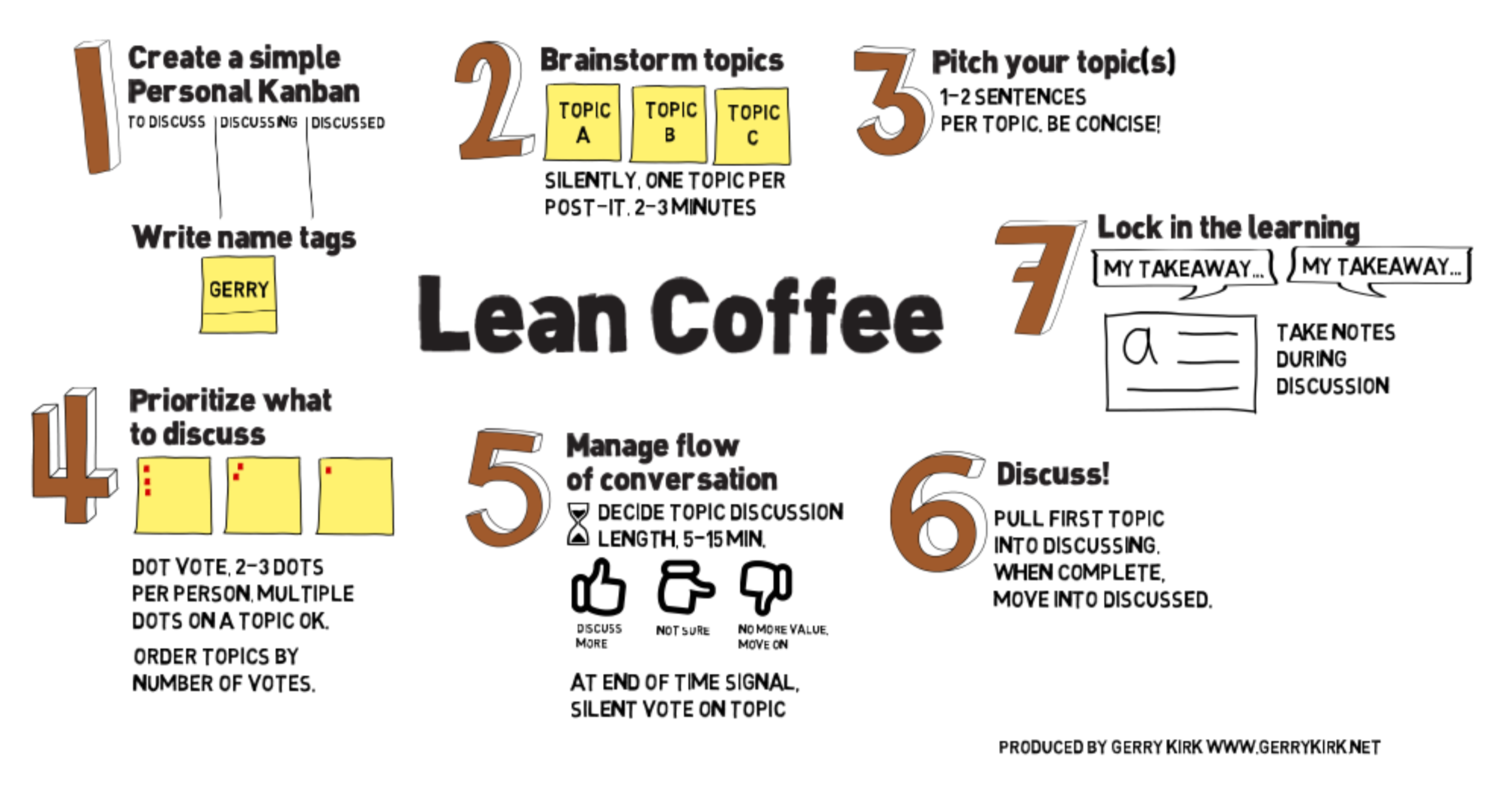
Lean Coffee is a structured, but agenda-less, meeting format used by teams to create a productive, participant-driven discussion.
It was created in 2009 by Jim Benson and Ryan Martens to solve the problem of boring, status-update meetings where the most important topics often get skipped because they are at the bottom of a fixed agenda.
Here is the core breakdown of how it works:
The Core Mechanics (The “How”)
Lean Coffee follows a simple, time-boxed process based on a kanban board (usually a whiteboard or a virtual board like Trello, Miro, or Mural).
- Build the Agenda (First 5-10 mins):
- Participants write down topics they want to discuss on sticky notes.
- There are no pre-set items; everything comes from the room.
- Vote (2-3 mins):
- Everyone gets a limited number of “dots” (or votes) to place on the topics they find most important.
- The notes are then reordered on the board from highest votes to lowest votes.
- The “Lean” Process (Iterative):
- The group pulls the top topic into the “Discussing” column.
- A timer is set (usually 5-8 minutes).
- The “Coffee” Process (Retrospective):
- When the timer goes off, the group does a quick Roman Vote (thumb up, down, or sideways) to decide the topic’s fate:
- 👍 (Thumbs Up): Keep talking (add 2-3 more minutes).
- 👎 (Thumbs Down): Move to the next topic.
- 🫱 (Thumb Sideways): Indifference; move on.
- When a topic is finished, it is moved to “Discussed.”
- The group pulls the next-highest-voted topic, sets the timer, and repeats until time runs out.
- When the timer goes off, the group does a quick Roman Vote (thumb up, down, or sideways) to decide the topic’s fate:
Key Principles (The “Why”)
- Just-in-Time: You don’t decide what to talk about until the meeting starts.
- Pull System: You only discuss what the group votes as valuable right now, not what was important last week.
- Timeboxing: Strict time limits prevent “scope creep” (e.g., arguing about one point for 45 minutes) and ensure that many topics are covered.
- Democracy: The facilitator does not set the agenda; the group does via dot voting.
When to Use It
- Retrospectives: Agile teams use them to discuss what went right and wrong without a preset list.
- Community of Practice: Groups trying to solve a common problem (e.g., “How do we improve QA testing?”).
- Strategy Brainstorms: When the leader doesn’t have all the answers and needs group intelligence.
- Stand-ups (rarely): To dig deep into a specific blocker that surfaced during a quick update.
Example in Practice
Imagine a 45-minute software team meeting.
- Step 1 (10 min): Everyone writes topics: “The API lag,” “Bill’s vacation coverage,” “New UI design,” “Coffee machine broken.”
- Step 2 (5 min): Dot voting. “API lag” gets 8 dots. “Bill’s vacation” gets 2.
- Step 3 (30 min): Timer set for 7 minutes on “API lag.” At 7 min, the team thumbs up (needs more time). They add 5 minutes. After that, thumbs down (done). Move to “New UI design” for the final 15 minutes.
Virtual Lean Coffee
Because this format works so well with sticky notes and timers, it is extremely popular in remote work. Tools like Miro, Mural, Conceptboard, or a simple Trello board with a timer bot in Slack/Teams replicate the experience exactly.
Lean Coffee turns a passive meeting where one person talks into an active, democratic marketplace of ideas. You vote with your attention in real time.