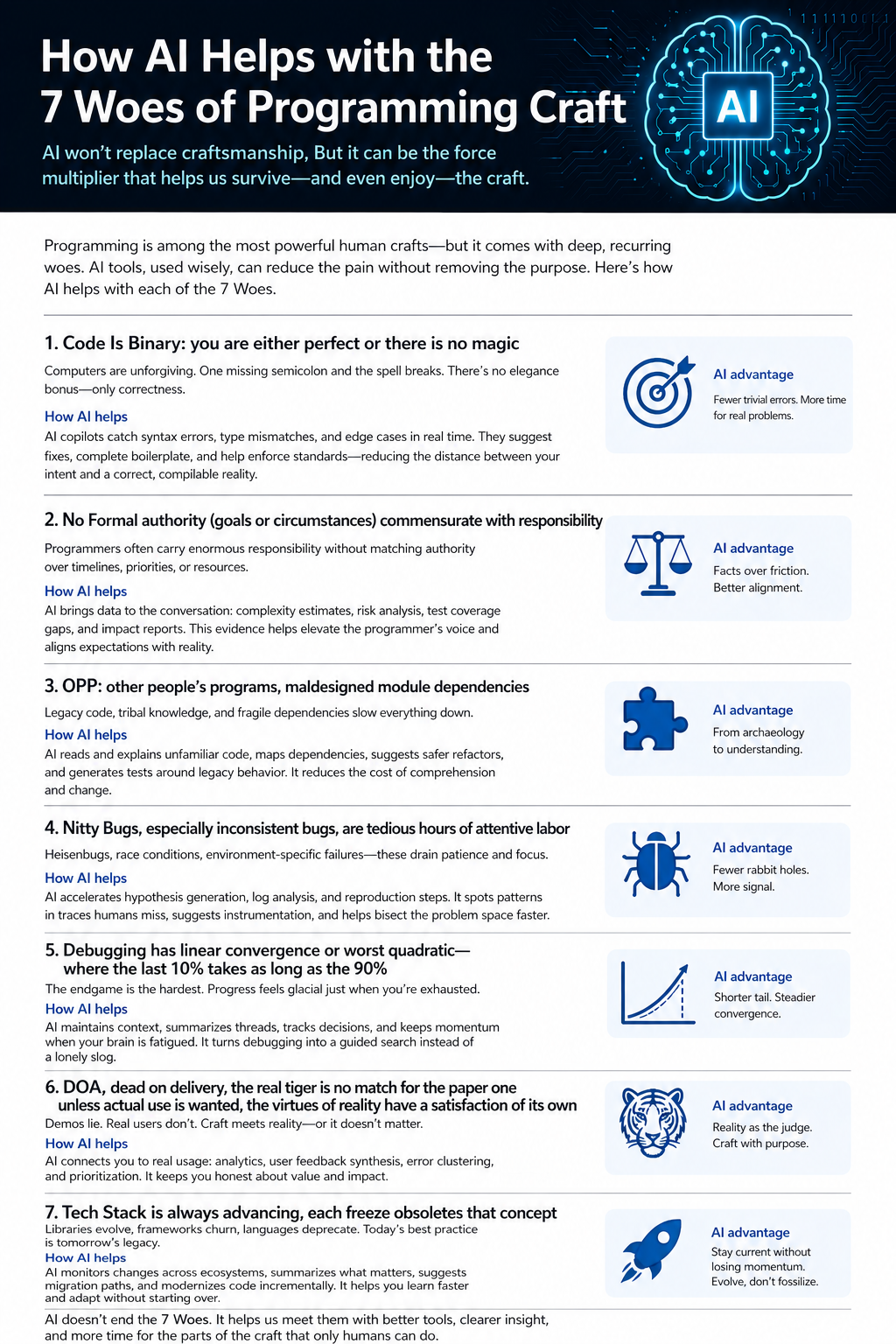
Programming has always been a craft of profound frustration and rare joy. In his seminal book (The Mythical Man-Month), Frederick Brooks identified seven “woes” that make software development uniquely difficult. Today, artificial intelligence is beginning to alleviate many of these pain points—not by eliminating the essential complexity of programming, but by automating the accidental tasks that consume developers’ time.
1. Code Is Binary: Perfect or Nothing
“You are either perfect, or there is no magic.”
There is no prize for 99.9% correct. Your logic looks good but your missed that semi colon.
Code either compiles and works, or it doesn’t. This unforgiving binary nature creates immense pressure.
How AI helps:
- Real-time error prevention: AI-powered IDEs like GitHub Copilot and Cursor flag syntax errors, type mismatches, and logical bugs before compilation.
- Auto-correction: When errors occur, AI instantly suggests fixes with explanations, reducing the “all-or-nothing” frustration.
- Test generation: AI creates unit tests automatically, ensuring code meets expectations before it’s ever run.
AI shifts the burden from “will it work?” to “how do I verify it works?”, making the binary nature less punishing.
2. No Formal Authority Commensurate with Responsibility
Programmers bear responsibility for system behavior but often lack authority over requirements, deadlines, or architectural decisions.
How AI helps:
- Documentation automation: AI generates and maintains documentation, giving developers concrete artifacts to reference when pushing back on unrealistic expectations.
- Impact analysis: AI tools can trace dependencies and quantify the impact of changes, providing data-driven arguments for scope or timeline adjustments.
- Requirement clarification: AI chatbots can clarify ambiguous requirements by cross-referencing specs with existing code, reducing misalignment.
AI empowers developers with evidence and automation, strengthening their position in negotiations.
3. OPP: Other People’s Programs & Maldesigned Dependencies
“Other People’s Programs” with tangled, poorly designed module dependencies are a constant headache.
How AI helps:
- Dependency analysis: AI maps complex dependency graphs and identifies problematic couplings or circular dependencies.
- Refactoring suggestions: Tools like Claude Code automatically propose safer, more modular replacements for poorly designed modules.
- Legacy code understanding: AI summarizes old codebases, explaining change histories and undocumented quirks to new team members.
AI acts as a translator between developers and legacy systems, reducing the cognitive load of navigating others’ code.
4. Nitty Bugs: Tedious Hours of Attentive Labor
“Finding nitty little bugs is just work… dreary hours of tedious, painstaking labor.”
Especially inconsistent, race-condition, or edge-case bugs consume hours of focused attention. A programming language side effect is one of the nightmare situations we can face as developers.
How AI helps:
- Fuzzing & property-based testing: AI automatically generates thousands of test cases to expose edge cases and concurrency bugs.
- Bug reproduction: AI analyzes stack traces and log files to reproduce intermittent bugs consistently.
- Root cause isolation: AI pinpoints the exact lines of code and conditions causing bugs, dramatically reducing diagnosis time.
What used to take hours of linear search now takes minutes of AI-assisted investigation.
5. Debugging’s Linear (or Quadratic) Convergence
“The last 10% takes as long as the first 90%.”
Debugging slows exponentially as bugs become subtler.
How AI helps:
- Intelligent breakpoints: AI suggests where to set breakpoints based on likely failure points.
- Symbolic execution: AI frameworks explore multiple execution paths simultaneously, finding elusive bugs faster.
- Confidence scoring: Advanced models indicate their confidence in fixes, helping developers prioritize verification efforts.
AI transforms debugging from a linear grind into a targeted, accelerated process.
6. (Implicit) Maintenance Grind
While Brooks focused on seven woes, modern programming adds the relentless maintenance burden: documenting, reviewing, and updating code for years.
How AI helps:
- Automated code reviews: AI scans pull requests for style, performance, and security issues.
- Change summarization: AI generates clear changelogs and migration guides for new team members.
- Technical debt tracking: AI identifies and prioritizes refactoring opportunities.
AI turns maintenance from a time-consuming black hole into a manageable, automated process.
7. DOA: Dead on Delivery
“The real tiger is no match for the paper one unless actual use is wanted… the virtues of reality have a satisfaction of their own.”
Software that never reaches real users—or fails in production—is “dead on delivery.” The gap between theoretical correctness and real-world utility is huge.
How AI helps:
- Rapid Prototyping: AI generates working prototypes in minutes, letting teams validate ideas with actual users before heavy investment.newsletter.pragmaticengineer
- Production simulation: AI simulates real-world usage patterns, load conditions, and edge cases before deployment.news.mit
- Continuous feedback loops: AI monitors production metrics and auto-suggests fixes, ensuring software evolves with actual usage.news.mit
AI narrows the gap between “paper tiger” and “real tiger” by accelerating the path from idea to real-world validation.
The Reality Check
AI is not a silver bullet. It still:
- Struggles with massive, proprietary codebases.
- Can hallucinate plausible-but-wrong code.
- Cannot replace human judgment in architectural decisions.
But as MIT researchers note, AI “quietly shoulders the drudgery of software development: refactoring tangled code, migrating legacy systems, and hunting down race conditions, so that human engineers can devote themselves to architecture, design, and the genuinely novel problems”
The 7 Woes of Programming remain, but AI transforms them from debilitating obstacles into manageable challenges—freeing developers to focus on the true joy of the craft: building things of their own design.gist.github