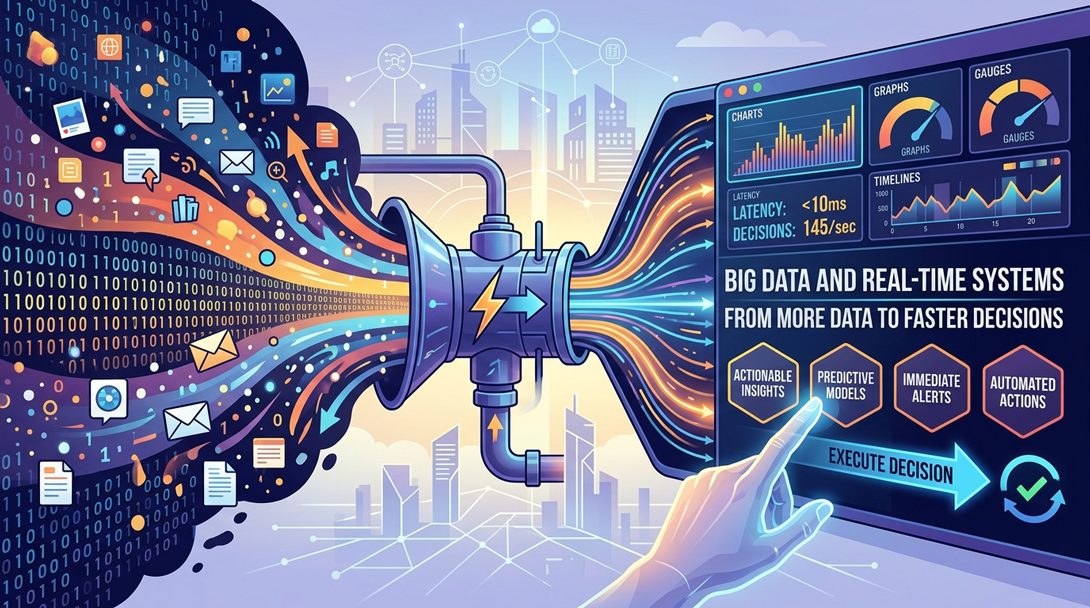
Big data was once defined primarily by how much data we had.
Today, that definition is no longer sufficient.
Organizations are collecting information from transactions, websites, mobile devices, cameras, sensors, machines, satellites, vehicles, and people. The challenge is no longer simply storing this information. It is processing the right data quickly enough to make it useful.
The evolution from big data to real-time systems represents a fundamental shift:
The value of data increasingly depends not only on its size, but on how quickly we can turn it into action.
The Three V’s: Volume, Velocity, and Variety
The classic definition of big data begins with three characteristics.
Volume: There is simply more of it
Organizations now generate data at enormous scale.
Customer transactions, application logs, social media interactions, financial records, sensor readings, and digital content can quickly produce terabytes, petabytes, or more.
Traditional approaches that depend on a single powerful server eventually reach their limits.
Big data architectures solve this by distributing storage and computation across many machines.
The important idea is not simply having a bigger computer.
It is having many computers working together.
Velocity: Data is arriving faster
The second challenge is speed.
A nightly report may have been sufficient when businesses operated primarily on daily cycles.
But consider:
- Fraud detection
- Stock trading
- Equipment monitoring
- Website personalization
- Cybersecurity
- IoT monitoring
- Customer recommendations
Waiting until tomorrow to process today’s data can make the information almost useless.
This creates the need for stream processing and real-time architectures.
Instead of:
Collect → Store → Process → Report
the architecture increasingly becomes:
Event → Process → Decide → Act
The closer analysis gets to the moment an event occurs, the more opportunities there are to automate decisions.
Variety: Data Is No Longer Just Rows and Columns
Perhaps the most profound change is variety.
Traditional enterprise systems were dominated by structured data:
Customer ID | Product ID | Date | Amount
But modern organizations collect much more.
Video
Security cameras, sports footage, autonomous vehicles, and manufacturing systems generate enormous quantities of video.
Voice
Call centers, virtual assistants, voice commands, and recorded conversations create valuable audio data.
Geospatial Data
GPS coordinates, maps, movement patterns, transportation data, and location services provide another dimension of information.
IoT
Sensors can continuously report:
- temperature,
- pressure,
- vibration,
- location,
- energy consumption,
- machine status.
Aerial and Satellite Imagery
Organizations can analyze enormous visual datasets to understand agriculture, weather, infrastructure, logistics, environmental changes, and geographic patterns.
This changes the fundamental question from:
“How do we store the data?”
to:
“How do we represent and analyze information that doesn’t naturally fit into a relational table?”
The Rise of Columnar Storage
As data volumes grew, another problem became obvious:
Reading unnecessary data is expensive.
Suppose a table contains 200 columns but a report only needs five.
A traditional row-oriented system may have to process far more information than the query actually needs.
Columnar storage approaches the problem differently.
Instead of storing:
Row 1 → all columns
Row 2 → all columns
Row 3 → all columns
it stores data by column:
Customer IDs → Customer IDs → Customer IDs
Revenue → Revenue → Revenue
Dates → Dates → Dates
Now an analytical query that needs only revenue and date can potentially read only those columns.
This becomes especially powerful when combined with compression.
Values in the same column tend to have similar characteristics, making them highly compressible.
The result is a powerful principle of modern data engineering:
Store less, read less, move less, and compute less.
Performance at scale often comes not from doing more work faster, but from avoiding unnecessary work altogether.
Distributed Computing: Divide the Problem
Big data also changed how we think about computation.
A dataset that is too large for one machine can be divided into smaller pieces and processed in parallel.
This is the fundamental idea behind distributed computing.
The Hadoop ecosystem helped popularize this architecture.
Hadoop Distributed File System distributed data across machines, while MapReduce provided a model for processing that data in parallel.
The important conceptual shift was:
Don’t bring all the data to the computer.
Instead:
Bring the computation to the data.
This principle continues to influence modern systems such as Spark and cloud data platforms.
The Evolution of the Big Data Toolkit
The tools used to work with big data have evolved considerably, but each represents an important idea.
Hadoop
Hadoop established a foundation for distributed storage and processing.
It demonstrated that large datasets could be handled by coordinating many relatively inexpensive machines rather than relying exclusively on increasingly powerful individual servers.
Sqoop
Sqoop addressed the problem of moving structured data between relational databases and Hadoop environments.
It represented an important transition:
Enterprise databases → Big data platforms
Pig
Pig provided a higher-level data transformation language that made large-scale data processing more accessible than writing low-level MapReduce programs.
Hive
Hive brought SQL-like querying to large distributed datasets.
This was an important development because organizations already had enormous amounts of SQL expertise.
Rather than forcing everyone to learn an entirely new programming model, Hive allowed analysts and engineers to use familiar concepts.
Redshift
Cloud data warehouses such as Amazon Redshift brought massively parallel analytical processing into a managed cloud environment.
The architecture remained fundamentally about distributed computation, but infrastructure management became increasingly abstracted away.
Cassandra
Cassandra represents a different approach to scaling.
Rather than optimizing primarily for complex analytical queries, it was designed for highly available, distributed workloads with enormous write and read requirements.
MongoDB
MongoDB popularized the document-oriented NoSQL model.
Instead of forcing every piece of information into a rigid relational structure, documents can represent more flexible and semi-structured data.
These technologies demonstrate an important lesson:
There is no single “big data database.”
The right technology depends on the workload.
Spark: The Engine That Makes Big Data Practical
One of the biggest shifts in big data has been the move from simply storing massive amounts of information to processing it efficiently. This is where Apache Spark changed the game. Unlike traditional Hadoop MapReduce, which repeatedly writes intermediate results to disk, Spark keeps much of the working data in memory and builds an optimized execution plan across a distributed cluster. This makes it particularly powerful for iterative workloads such as analytics, machine learning, streaming, and interactive data exploration.
Spark also provides a common programming model for working across different types of data. Its DataFrame and SQL APIs allow engineers and analysts to process structured and semi-structured data without having to think about every detail of distributed execution. Behind the scenes, Spark’s optimizer can handle tasks such as partitioning, filtering, joins, and aggregation across many machines.
The real value of Spark, however, is not simply speed. It is the ability to turn big data into usable data. A petabyte of raw logs, IoT events, transactions, or customer interactions has limited value sitting in storage. Spark can filter, enrich, aggregate, and transform that massive dataset into a smaller, meaningful dataset that people, dashboards, applications, and AI systems can actually use.
That leads to an important principle of modern data architecture:
The goal of big data isn’t to manage more data. It’s to extract more value from it.
Spark becomes the bridge between data at scale and decisions at speed.
Big Data Becomes Real-Time Data
The next evolution is moving from simply processing enormous datasets to processing events as they happen.
Consider a credit-card transaction.
A traditional architecture might store the transaction and analyze it later.
A real-time architecture can evaluate the transaction immediately:
Transaction → Fraud Model → Risk Score → Decision
The same pattern applies to thousands of other situations.
A machine begins vibrating abnormally.
Sensor → Stream → Detection → Alert → Maintenance
A customer visits a website.
Click → Event Stream → Recommendation Engine → Personalized Offer
A security system detects unusual network behavior.
Network Event → Analysis → Risk Detection → Response
This is where big data becomes operational.
The goal is no longer merely to understand what happened.
It is to respond while it is happening.
The Real Value of Big Data
There is a temptation to measure big data by its size.
Petabytes sound impressive.
Millions of events per second sound impressive.
Thousands of servers sound impressive.
But none of these numbers automatically create value.
The real value comes from the ability to transform:
Volume → Information
Information → Insight
Insight → Decision
Decision → Action
And increasingly:
Action → New Data → Better Decision
That final feedback loop is what makes real-time systems so powerful.
The system acts.
The action creates new data.
The new data improves the model.
The improved model produces a better action.
The cycle repeats.
The Modern Big Data Mindset
The most important lesson from the evolution of big data is that technology should follow the nature of the problem.
If the problem requires complex transactions, a relational database may be appropriate.
If it requires massive analytical queries, a columnar MPP platform may be better.
If it requires flexible documents, a document database may make sense.
If it requires enormous distributed availability, a system such as Cassandra may be appropriate.
If it requires real-time event processing, streaming architecture may be necessary.
The modern data expert therefore doesn’t ask:
“Which database is best?”
The better question is:
“What does the data need to do?”
How much data?
How quickly does it arrive?
How long must it be retained?
How frequently does it change?
Who consumes it?
What decisions depend on it?
What happens if the data is late?
What happens if it is wrong?
And most importantly:
What action will this data enable?
From Big Data to Intelligent Systems
Big data began with the problem of scale.
Real-time systems added the problem of speed.
Modern data architecture adds context, intelligence, and action.
The journey can be summarized simply:
More Data → Faster Data → Better Data → Smarter Decisions → Automated Action
The winners will not necessarily be the organizations with the most data.
They will be the organizations that can move from data to action faster—and learn from the results continuously.
That is the real promise of big data and real-time systems.