Updated: August 2026 (This guide has been fully revised from our 2013 original to reflect the current digital landscape.)
What Is a Digital Strategy?
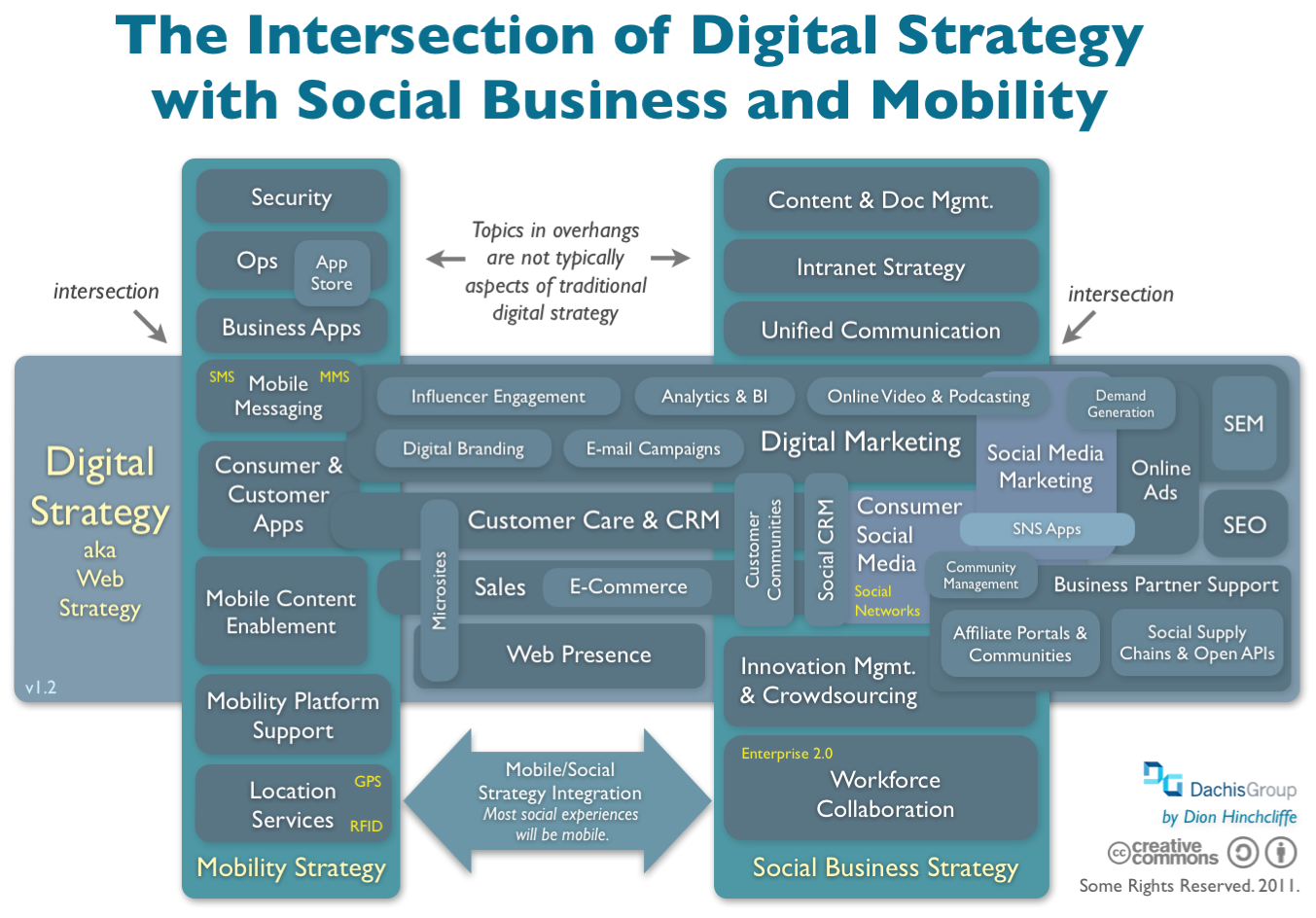
A digital strategy is not a collection of social-media accounts, campaigns, or marketing tools. It is a set of coordinated decisions about which customers a business will serve, what value it will provide, how it will deliver that value across digital and physical touchpoints, and how it will measure and improve the results.
A strong strategy connects business goals to customer needs, channel roles, content, technology, data governance, and measurement. It answers practical questions: Which audiences matter most? What outcome are we trying to change? Which experiences will move customers from discovery to loyalty? What data can we responsibly use? How will we know whether the investment worked?
The goal is not to be present everywhere. It is to create a consistent, useful experience in the places that matter most to customers—and continuously improve it using trustworthy data.
This guide walks you through the 8 components of a modern digital strategy, with a practical example, a diagnostic checklist, and a 90-day implementation plan to get started.
Start with Business Outcomes
A digital strategy begins with business objectives, not channels. Avoid starting with “We need a TikTok strategy” or “We should redesign our website.” Instead, ask: What business problem are we solving?
Examples of meaningful business outcomes:
- Increase qualified sales pipeline by 25%
- Improve customer retention by 15%
- Reduce service costs by 20% through self-service
- Increase subscription renewal rates
- Drive store visits through digital discovery
- Improve brand consideration among a new audience segment
Working Example:
Goal: Increase qualified B2B demo requests by 25% in six months.
This goal is specific, measurable, time-bound, and tied to revenue. Every subsequent decision—audience, channels, content, measurement—flows from this objective.
Define Priority Audiences and Jobs-to-be-Done
Once you know your business outcome, identify the audience segments most likely to help you achieve it. Go beyond basic demographics to understand their context, needs, and barriers.
Questions to answer:
- Who are they? (Firmographics, role, seniority)
- What problem are they trying to solve?
- What barriers prevent them from solving it today?
- What triggers them to look for a solution?
- Where do they go for information?
Working Example:
Audience: Operations leaders at mid-market firms (100–1,000 employees) who currently manage workflows using spreadsheets and manual processes.
Problem: They spend 8+ hours per week on manual reporting and face increasing audit risk.
Trigger: A quarterly audit finding or a new compliance requirement often prompts them to seek a solution.
Design the Value Exchange and Experience
For every touchpoint, define what the customer receives and what you receive in return. This is the value exchange.
| Touchpoint | Customer Receives | Business Receives |
|---|---|---|
| Blog post / search result | Useful, relevant information | Trust, awareness, traffic |
| Comparison guide | Clarity on options | Consideration, lead (email capture) |
| Case study | Social proof, risk reduction | Deeper engagement |
| Product demo | Hands-on experience | Qualified lead |
| Onboarding email | Guidance, success tips | Activation, retention |
| Support article | Self-service help | Reduced support cost |
Working Example:
Value proposition: “Reduce reporting time from 8 hours per week to 30 minutes, with automated, auditable workflows that reduce compliance risk.”
Experience flow:
- Operations leader searches for “automated workflow audit trail” and finds a comparison guide.
- They download the guide, providing an email address.
- They receive a case study showing how a similar firm reduced audit findings by 40%.
- They book a demo with sales.
- Post-demo, they receive an interactive ROI calculator.
- They become a customer and receive onboarding emails that drive product adoption.
Choose Channels by Role
Different channels serve different roles in the customer journey. Map channels to specific purposes rather than chasing every new platform.
| Journey Stage | Channel Role | Example Channels |
|---|---|---|
| Discovery | Build awareness and reach new audiences | Organic search, paid search, LinkedIn, industry publications, podcasts |
| Consideration | Educate, build trust, compare | Website content, email nurture, case studies, reviews, demos, webinars |
| Conversion | Drive action | Landing pages, sales enablement, checkout, live chat |
| Retention | Onboard, support, grow | Lifecycle email, in-app messaging, support, community, loyalty programs |
Working Example:
Stage Channel Role Specific Activity Discovery Search SEO-optimized comparison guides targeting “workflow audit automation” Discovery Social LinkedIn thought leadership on audit compliance trends Consideration Site Case study showing a mid-market firm’s results Consideration Nurture sequence with an ROI calculator Conversion Landing page Short demo request form (3 fields) Retention Onboarding sequence with success tips
Build the Data and Measurement System
You cannot improve what you do not measure. Build a measurement system that connects activities to outcomes, not vanity metrics.
Key measurement principles:
- Track events (specific actions), not just pageviews
- Integrate with your CRM to close the loop on revenue
- Define KPIs at every journey stage
- Use a mix of attribution methods, not one alone
Working Example KPIs:
| KPI | Definition | Target |
|---|---|---|
| Qualified-demo rate | % of website visitors who book a demo | 3% |
| Cost per qualified opportunity | Ad spend ÷ qualified demos | <$250 |
| Opportunity-to-win rate | % of qualified demos that become customers | 30% |
| Sales-cycle length | Days from demo to close | <45 days |
| Retained revenue | 12-month average revenue per customer | >$15,000 |
Attribution:
Google Analytics 4 supports data-driven attribution, which assigns conversion credit based on observed customer paths rather than treating the final touchpoint as solely responsible.[^1] However, attribution is one input—not the whole decision system. Combine it with:
- A/B testing to measure causal impact of changes
- Incrementality testing to measure true lift from paid channels
- CRM cohort analysis to track customer lifetime value by acquisition source
- Marketing-mix modeling (MMM) for larger budgets, measuring impact across online and offline channels
Govern Responsibly
A modern digital strategy must embed privacy, consent, and ethical data use from the start. This is not a compliance checkbox—it builds customer trust.
Essential governance elements:
- Consent management: Obtain and record explicit consent for data collection and use
- First-party data strategy: Collect your own data through value exchanges, not third-party proxies
- Data minimization: Collect only what you need
- Retention limits: Delete data when it no longer serves a purpose
- Access controls: Limit internal access to sensitive customer data
- Transparency: Make your privacy policy clear and accessible
- Data quality: Maintain accurate, up-to-date records
Working Example:
- Consent is collected via a clear opt-in on the demo request form and website cookie banner
- Data is retained for 24 months after customer relationship ends
- Access to CRM data is restricted to sales and marketing roles with specific business need
- Privacy policy is linked in the footer and pre-demo email
Operate and Improve
A strategy is only as good as its execution and iteration. Establish a cadence of review and improvement.
Key operational practices:
- Assign accountable owners for each component (e.g., channel manager, analytics lead, data governance owner)
- Maintain a content and experiment backlog with prioritized tests
- Review results on a defined cadence: weekly for metrics, monthly for strategy, quarterly for outcomes
- Close the learning loop: document what worked and apply learnings to future work
Working Example:
- Weekly: Review qualified-demo rate and adjust landing page copy
- Monthly: Review cost per qualified opportunity, shift budget to better-performing channels
- Quarterly: Review overall progress against 25% increase, refine audience segments
- Testing: Run an A/B test on demo request form length; run an incrementality test on LinkedIn spend[^2]
Diagnostic Checklist
Use this to assess your current strategy readiness:
- □ We have clearly defined business objectives for our digital activities
- □ We have a documented understanding of our key customer personas and their jobs-to-be-done
- □ We have mapped our channels to specific journey-stage roles
- □ We use a combination of attribution, experimentation, and cohort analysis for measurement
- □ Our technology stack provides a unified view of the customer
- □ We have a documented consent management process
- □ We have data retention, minimization, and access control policies
- □ We review results weekly, monthly, and quarterly
- □ We have assigned owners for each component of our strategy
- □ We maintain a backlog of tests and content improvements
90-Day Implementation Plan
| Phase | Timeline | Focus and Actions |
|---|---|---|
| Discovery and Foundation | Days 1–30 | Audit current digital channels, data capabilities, tech stack, and customer understanding. Define your primary business objective (e.g., qualified demo requests +25%). Interview key internal stakeholders to align on priorities. |
| Detailed Strategy and Planning | Days 31–60 | Draft customer personas and journey maps. Document governance policies (consent, retention, access). Choose primary attribution model and plan first incrementality test. Develop content and channel role plan aligned to journey stages. |
| Implementation and Experimentation | Days 61–90 | Launch first campaigns based on new plan. Set up dashboards and KPIs. Begin A/B testing. Start weekly “Data and Decisions” review. Document learnings and adjust plan for next quarter. |
This article was reviewed and updated in August 2026.
[^1]: Google Analytics 4 Data-Driven Attribution. [support.google.com/analytics/answer/10596866](https://support.google.com/analytics/answer/10596866?hl=en)
[^2]: For guidance on incrementality testing, see Meta’s measurement resources and academic literature on controlled marketing experiments.
What is your biggest digital strategy challenge right now? Share your thoughts in the comments below, or download our companion [Digital Strategy Diagnostic Workbook] to get started.
We have to look at the progress of IT to understand what a digital strategy looks like. Computers were traditionally for corporations where custom applications were built to process their workflow. This was limited to business transactional processing and reporting to monitor the efficiency of that business.
In the 1980’s when the internet and emailing became main stream it opened up the consumer computer market. In the early years this was limited since many companies were now coming online with their website and content. Out bound email marketing was the first signs that the marketing function was going to join the digital revolution.
In the 2000’s there were some key transformations that revolutionize the way we think of digital and marketing. The first big change was web 2.0 which ment that customers were not only finding the content they were searching for but leaving their sentiments behind. This two way interaction started growing the digital channel and shrinking the TV, prints and radio channels. The second big change was social media. In the age of YouTube, Facebook, Twitter, Pintrest and many more the amount of communities further split the channels out to become more segmented. Each of these channels tend to attract a different type of consumer. Early adopters tend to like twitter and trending blogs. The lagers tend to use many of the other online channels. The third change is smart phone and mobile device usage. The smart phone has radically transforming the way information is created and stored. We need to access information on the run and in real time.
If your company’s idea of a digital strategy is setting up a Facebook page and twitter account then I am not sure how you will really meet your objective. Companies must now consider multi-channel marketing and multi prong approaches in the digital space. These must also consider inbound and out bound channels. There must be a unified strategy of naming and measuring the key performance indicators across all strategies and measuring how they interact together to make the final sales transaction. For example was it a web search that allowed the customer to see the website then make a purchase or was it the tv or magazine print? Customer interaction history can only be gathered and measured in digital formats. This measure of “attribution” as marketers refer to it, is how the budget should be placed per channel like direct mail, email, web search, web /print ad, social media interaction, on the phone or in person. I am sure each of them plays in making customers receptive to the final marketing touch point before the purchase.
This is not to intimidate anyone but the complexity is not going to get simpler as the years pass. Marketing to customers is heading toward a segmentation of one. “Give me what I want and understand me”. This is where the industry has always wanted to go and it is accelerated in the digital age. When we think about branding and marketing to a client, it really comes down to how we operate and how we communicate in synch in each channel.
The future of marketing is going to be digital (read more how spending will go up) but the question is do you really have a strategy? Big Data can give you the insight to create a real digital strategy. We will explore how in this article
Stephen Choo Quan
Stephen is a double threat, holding both AWS and SAP BusinessObjects certification as an architect and certification as an IBM DB2 Database Developer. More about the Author