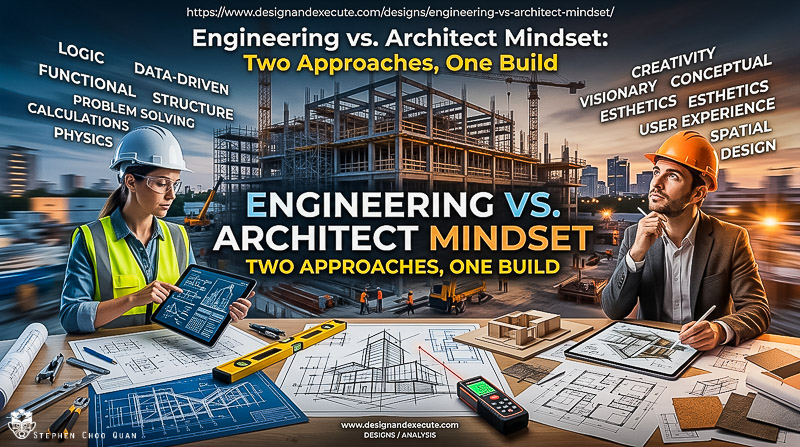
The difference between an engineering mindset and an architect mindset comes down to how each approaches a problem, what they optimize for, and the time horizon they consider.
Here’s a breakdown across the key dimensions:
1. Core Question Each Asks
- Engineer: “How do we build this correctly, efficiently, and reliably?”
- Architect: “What should we build, and how does it fit into the whole system over time?”
The engineer focuses on execution within constraints; the architect focuses on framing the problem and the constraints themselves.
2. Primary Orientation
| Dimension | Engineering Mindset | Architect Mindset |
|---|---|---|
| Focus | The part / the component | The whole / the system |
| Optimizes for | Correctness, performance, maintainability of a solution | Coherence, trade-offs, evolvability of the system |
| Time horizon | Near-to-mid term (deliver the thing) | Long term (how it ages, scales, changes) |
| Risk posture | Reduce technical risk in implementation | Manage strategic and systemic risk |
| Success metric | “It works, it’s clean, it’s tested” | “It fits, it scales, it enables what comes next” |
3. How They Think About Trade-offs
- Engineer: Tends to solve the problem in front of them well — choosing the right algorithm, design pattern, or tool. Trade-offs are often local and concrete (speed vs. memory, simplicity vs. flexibility).
- Architect: Trades off across competing stakeholders and forces — cost vs. capability, short-term delivery vs. long-term flexibility, consistency vs. autonomy of teams. Often must choose between options where no option is clearly right.
4. Scope and Abstraction
- Engineer works comfortably inside an abstraction boundary — takes interfaces as given and builds well within them.
- Architect draws and redraws the boundaries — decides where modules, services, teams, and responsibilities should be separated, and what contracts connect them.
5. Relationship to Ambiguity
- Engineer: Thrives on resolving ambiguity into concrete design — turning a spec into code, a requirement into a test.
- Architect: Thrives on operating in ambiguity — gathering incomplete information from many sources, making decisions with incomplete data, and documenting the rationale so others can act.
6. Deliverables and Artifacts
- Engineer: Code, tests, designs of components, runbooks, performance profiles.
- Architect: Decision records (ADRs), system diagrams, principles and standards, capability roadmaps, trade-off analyses, interface contracts.
7. A Useful Analogy
- The engineer asks: “Is this bridge strong enough, and is it built right?”
- The architect asks: “Should the bridge go here at all? How does it connect to the road network, the city’s growth, and the river’s ecology over 50 years?”
8. Important Caveats
- These are modes, not job titles. A senior engineer often thinks architecturally; a good architect still thinks like an engineer. The best practitioners switch between modes deliberately.
- They’re complementary, not hierarchical. Architecture without engineering rigor is fantasy; engineering without architectural thinking produces locally optimal but globally incoherent systems.
- The architect mindset carries more “political” and communication weight — aligning people, negotiating constraints, and making decisions legible to stakeholders. The engineering mindset carries more technical depth and precision.
In One Sentence
The engineering mindset asks “How do we build this well?” — the architect mindset asks “What should we build, and how will it hold together as everything changes?”
The mature professional develops both and knows when to zoom in and when to zoom out.