Modern data work is often described through technologies: databases, cloud platforms, AI, analytics, pipelines, and visualization tools.
But technology is only part of the equation.
The hardest data problems are rarely solved by technology alone. They are solved when people with different expertise can work together to turn business problems into useful decisions.
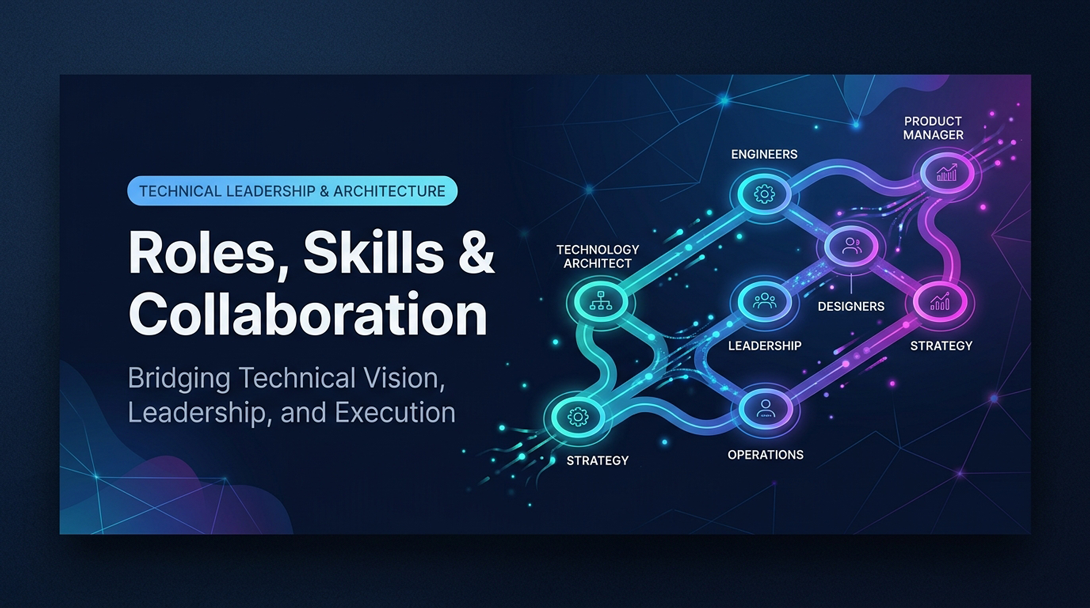
The modern data organization therefore needs more than data engineers and data scientists. It needs domain experts, architects, analysts, designers, integrators, product managers, and leaders who can connect technology to human needs.
The competitive advantage is not simply having better tools.
It is having people who know how to use those tools together.
The Data Scientist Is More Than a Statistician
A common misconception is that a data scientist is simply someone who knows statistics and machine learning.
Statistics is certainly important.
Technology is important too.
But neither is sufficient.
A useful way to think about the modern data scientist is:
Data Scientist = Statistics + Technology + Domain Expertise
Statistics enables determining whether a relationship is meaningful, quantifying uncertainty, testing hypotheses, and distinguishing signal from noise.
Technology provides the ability to acquire, process, model, and analyze increasingly large and complex datasets.
But domain expertise provides something neither of these can provide on their own:
context.
A model may identify a statistically significant relationship. But is it meaningful to the business?
A machine-learning model may predict customer behavior. But why does that behavior matter?
A dashboard may show that performance declined. But what operational decision should follow?
Without domain understanding, data science can become an impressive exercise in answering questions nobody needs answered.
The best data scientists therefore understand both the forest and the trees.
They can work at the technical level while continually asking:
What business problem are we actually trying to solve?
No One Person Has All the Answers
Complex data problems cross organizational boundaries.
The person who understands the business may not understand the technology.
The engineer who understands the pipeline may not understand the customer.
The data scientist who understands the model may not understand how the organization actually operates.
The architect may understand the entire system but not the details of a particular business process.
That is why effective data organizations rely on cross-functional teams.
A typical team might include:
- Subject Matter Experts (SMEs) who understand the business
- Data Engineers who build and operate data pipelines
- Data Scientists who analyze data and build models
- Data Analysts who explore data and communicate findings
- Integrators who connect systems and data sources
- Architects who design the broader technology and data ecosystem
- Product Managers who connect capabilities to customer and business outcomes
- Designers who ensure the resulting experiences actually work for people
The objective isn’t simply to put all these people in the same meeting.
It is to create shared understanding.
Collaboration Requires Translation
Every discipline has its own language.
The business might talk about: Revenue, customers, risk, retention, and profitability.
The data team might talk about: Schemas, pipelines, partitions, models, features, and data quality.
The technology team might talk about: APIs, services, events, infrastructure, latency, and scalability.
The customer might simply say: “I need this to be easier.”
Someone has to connect all these perspectives.
That is one of the most valuable skills in modern data work:
translation.
The ability to take a business problem and translate it into a data problem.
Then translate the data problem into a technology solution.
Then translate the technology solution back into a business outcome.
The people who can move fluently between these worlds become extraordinarily valuable.
The Most Important Skills Aren’t Always Technical
Technical skills can get you into the conversation.
But they are often not what determines how much influence you have once you are there.
Four skills become particularly important.
1. Leadership
Leadership in data does not necessarily mean managing people.
It means creating direction.
A data leader asks:
- What are we trying to accomplish?
- What matters most?
- What should we stop doing?
- What decision needs to be made?
Leadership turns analysis into movement.
2. Strategic Thinking
Having data is not the same as having strategy.
Strategic thinking means connecting information to objectives.
Instead of asking: “What does the data say?”
Ask:
“What does this mean for our strategy?”
And then:
“What should we do differently?”
The progression is:
Data → Insight → Implication → Action
The person who can make that connection is much more valuable than someone who can simply produce another report.
3. Communication
Data professionals often assume that better analysis automatically produces better decisions.
It doesn’t.
People need to understand the analysis.
That requires communication.
A technically correct analysis that nobody understands has little practical value.
Effective communication means knowing when to use:
- A chart
- A number
- A comparison
- A story
- A recommendation
- An example
- A simple explanation
The goal isn’t to demonstrate how much you know.
The goal is to make the other person understand what matters.
4. Relationship-Building
Data is fundamentally collaborative.
You need the business to give you context.
You need engineers to provide reliable data.
You need stakeholders to explain what success means.
You need users to tell you whether the solution actually works.
Trust makes this possible.
The strongest data professionals therefore build relationships before they need them.
They don’t simply show up when they need access to a dataset.
They become trusted partners.
Designer vs. Developer
There is another important distinction in modern technology work.
Developers tend to ask:
Can we build it?
Designers tend to ask:
Should we build it this way?
A developer naturally thinks about implementation, architecture, performance, correctness, and maintainability.
A designer adds another perspective:
- Who is using this?
- What are they trying to accomplish?
- What do they already know?
- What might confuse them?
- What will they expect to happen?
- What happens when they make a mistake?
- How does this fit into their workflow?
This is the difference between a developer mindset and a designer mindset.
Both are necessary, (hence the website name).
Empathy Is an Engineering Skill
Empathy is sometimes treated as something belonging to designers rather than technologists.
That is a mistake.
Communication is operationaized empathy.
Consider a data dashboard.
A developer may successfully build a dashboard that queries the correct database, calculates the correct metrics, and renders the correct charts.
Technically, it works.
But if the user cannot quickly understand what requires attention, the system has failed.
The designer asks:
What does the user need to know?
The developer asks:
How do we make the system do it?
The best teams ask both questions.
This is especially important as AI and data systems become more powerful.
As the technology becomes more sophisticated, the human experience becomes more important, not less.
Build for the Person, Not Just the System
A technically elegant system can still be a terrible product.
A perfectly normalized database can be difficult to use.
A highly optimized data pipeline can deliver information nobody needs.
A sophisticated AI model can produce predictions that don’t lead to action.
A beautiful dashboard can overwhelm its audience.
Modern data professionals therefore need to think beyond the technology itself.
The complete system includes:
Technology + Data + Process + People
Ignoring any one of these creates risk.
The Modern Data Team Is a Network of Expertise
The future does not belong to the person who knows everything.
It belongs to the person who knows how to connect the people who know different things.
A data scientist brings statistical reasoning.
An engineer brings technical execution.
A domain expert brings context.
An architect brings systems thinking.
A designer brings empathy and usability.
A product manager brings prioritization.
A leader brings direction.
Together, they create something none of them could create independently.
That is the real meaning of collaboration.
From Data Experts to Outcome Leaders
The evolution of the modern data professional is therefore not simply:
Learn more tools.
It is:
Understand more perspectives.
Learn the technology.
Understand the data.
Learn the business.
Understand the customer.
Develop analytical judgment.
Learn to communicate.
Build relationships.
Develop empathy.
Then connect all of those capabilities to outcomes.
The ultimate measure of a data professional is not how many technologies they know.
It is whether they can help an organization understand reality, make better decisions, and act with greater confidence.
Technology gives us capability.
Data gives us evidence.
Domain expertise gives us context.
Design gives us empathy.
Leadership gives us direction.
And collaboration brings it all together.
The future of data belongs not to isolated experts, but to teams that can turn collective expertise into collective intelligence.