The Drum-Buffer-Rope (DBR) method and the broader Theory of Constraints (TOC) are not only applicable but are increasingly recognized as highly effective frameworks for managing and accelerating software and data engineering projects.
While originating in manufacturing, these principles translate powerfully to the knowledge work of engineering. The core idea—that every complex system has a single constraint (or bottleneck) that limits its overall throughput—is a universal truth.
Here is a breakdown of how they work in this context:
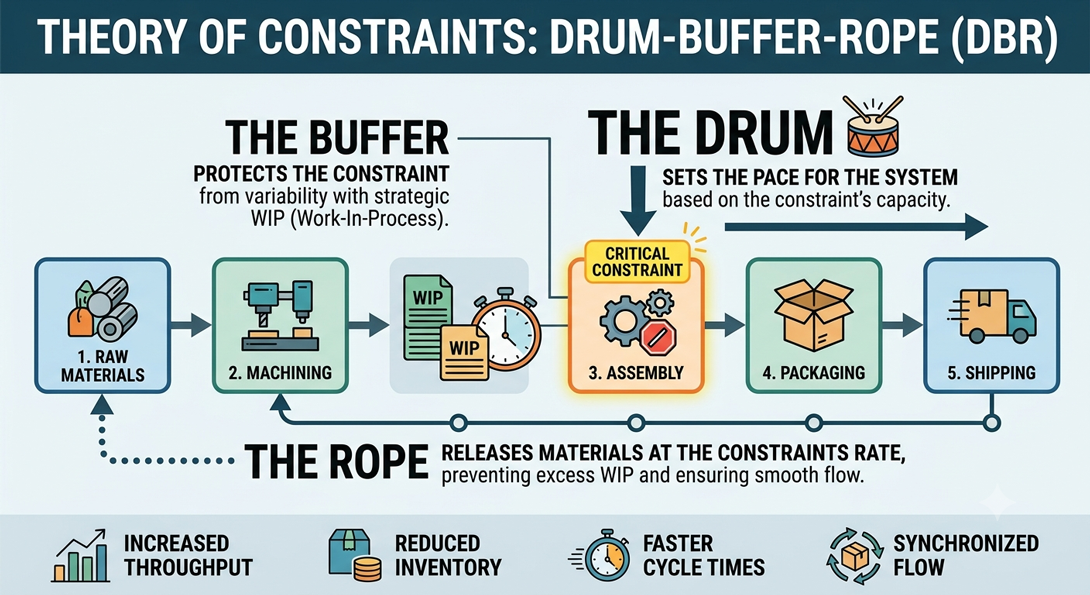
🥁 The Drum: The Pace-Setter for the Project
In software and data engineering, the “Drum” is the system’s constraint, which dictates the maximum achievable throughput of the entire project.
- What it looks like: This could be a data pipeline bottleneck (e.g., a slow transformation step that can’t keep up with incoming data), a code review queue that is perpetually backlogged, a specific testing environment that is slow and unreliable, or a key team member (like a DBA or data architect) who is a single point of failure.
- The Action: You must identify this step and then plan the entire project’s schedule and workflow around its capacity to ensure you don’t overwhelm it with work.
🪣 The Buffer: Protection Against Uncertainty
The “Buffer” is a strategic time or work-in-progress (WIP) cushion placed in front of the constraint. Its purpose is to ensure the constraint never starves for work, even when upstream tasks (like data ingestion or feature development) are delayed.
- What it looks like: This translates to maintaining a prioritized queue of tasks—such as data transformation jobs or fully developed, ready-to-test features—that are waiting just for the bottleneck resource.
- The Action: You manage the size and health of this buffer. If the buffer is shrinking, it’s a warning that upstream delays may soon halt the entire project. If it’s growing too large, you might be “overproducing” work that isn’t yet needed, which is wasteful.
🪢 The Rope: Synchronization and Control
The “Rope” is a communication and signaling mechanism that controls the release of new work into the system, ensuring it is perfectly synchronized with the Drum’s capacity.
- What it looks like: This means you do not start work on a new feature or data pipeline component just because you have the capacity. Instead, new work is “pulled” into the system only when there is space in the buffer of the constraint.
- The Action: This is often implemented by limiting WIP in an agile workflow, similar to a Kanban system. The “Rope” prevents the system from being flooded with work that will only create bottlenecks and delays elsewhere.
📈 Application in Data Engineering: A Concrete Example
Recent research highlights a direct application for data teams . For instance, the DBR method has been studied in integration with Scrum-Kanban for agile data projects. In this model:
- The constraint (Drum) might be a complex data transformation job in a pipeline.
- The Buffer is the number of “ready-to-run” jobs waiting for the transformation engine.
- The Rope is the WIP limit on the Kanban board, ensuring that data ingestion doesn’t push more raw data into the system than the transformation step can handle.
The research demonstrated that this focused approach can maximize the amount of completed work (throughput) while minimizing inventory (unprocessed data).
🔄 The Five Focusing Steps in Practice
The broader TOC provides a simple, iterative roadmap to improve your systems :
- Identify the constraint: Find the bottleneck. (e.g., “Our analytics development cycle is stalled at the data modeling step.”) .
- Exploit the constraint: Get the most out of it without spending money. (e.g., “Stop the data modeler from being in non-essential meetings. Ensure all their work is ready and prioritized.”).
- Subordinate everything else: Align the rest of the team to support the constraint. (e.g., “Data ingestion engineers should only process and prepare data that the modeler is scheduled to work on next.”).
- Elevate the constraint: If the bottleneck is still too slow, invest to break it. (e.g., “Hire a second data modeler or invest in a faster modeling tool.”).
- Repeat: Once you improve one bottleneck, another will appear. This is a process of continuous improvement.
✅ Key Insights for Implementation
- Focus on Throughput, Not Cost: TOC emphasizes that increasing throughput (delivering valuable, working software or data products) is more important than cutting costs on individual tasks. An excessive focus on cost reduction can inadvertently damage the capability to deliver.
- Optimize the Whole System, Not Parts: It’s a common trap to optimize individual teams (e.g., making data ingestion 20% faster), but if that only creates more work for the bottleneck, overall throughput doesn’t improve. The goal is to improve the entire “data supply chain”.
I hope this breakdown helps you see how to apply these powerful principles to your own projects.